Bloomberg highlights Delcy Rodríguez: the Venezuelan president leads Latin America's largest image rebound
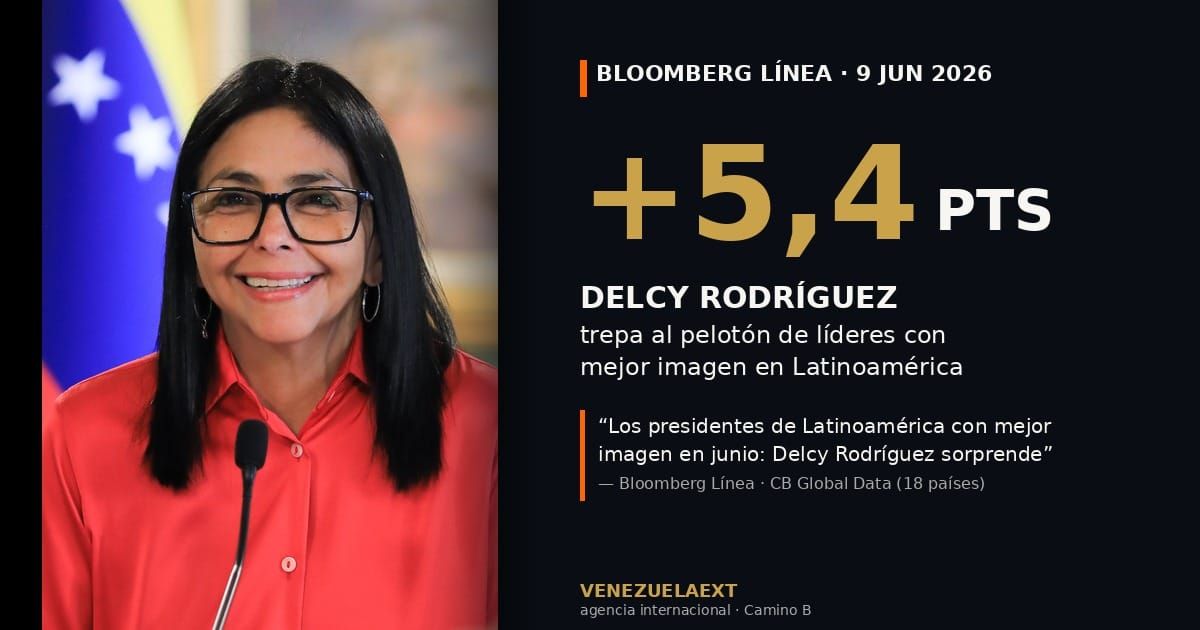
Bloomberg Línea headlines its June Latin American presidential ranking with the word "surprises": +5.4 points for Acting President Delcy Rodríguez, the highest monthly image growth among the 18 leaders measured by CB Global Data.
VenezuelaExt — June 10, 2026
By Javier "El Profe" Romero
Bloomberg Línea —the international economic outlet of reference for Latin America, integrated into Bloomberg's editorial ecosystem— placed the performance of the Acting President of the Bolivarian Republic of Venezuela, Delcy Rodríguez, at the center of its continental political analysis this Tuesday. The outlet headlined its coverage of the June regional presidential ranking with one unmistakable word: "surprises." The piece, titled "The presidents of Latin America with the best image in June: Delcy Rodríguez surprises," highlights that the Venezuelan leader was the one whose image improved the most among the 18 heads of state measured in the region, with a jump of 5.4 percentage points that takes her from 24.1% to 29.5% in favorability in a single month, according to the CB Global Data survey (Bloomberg Línea).
Bloomberg Línea's editorial choice is the news. In a Latin American landscape dominated by governance erosion —eight leaders fell in image compared to the previous month— the international outlet chose to highlight the Venezuelan case as the positive exception of the regional board. Bloomberg states the conclusion in plain words: Rodríguez's rebound "coincides with announcements about the return of oil companies to Venezuela and a tour through India to promote commercial opportunities."
KEY FIGURE: Bloomberg Línea titles its analysis of the June Latin American presidential ranking with the word "surprises" applied to Delcy Rodríguez's performance, who registered the largest monthly image growth among the 18 leaders measured: +5.4 percentage points, from 24.1% to 29.5%. Source: Bloomberg Línea, June 9, 2026.
Why it matters that it's Bloomberg
It is no small thing that the first international reading comes from a media outlet of this stature. Bloomberg Línea operates from a moderate editorial matrix, oriented toward rigorous analysis of markets, macroeconomic indicators and regional governance dynamics. It is the economic-political reading that foreign ministries, investment funds and regional analysts consult to take the continental pulse. When an outlet of that line chooses to headline a presidential ranking with the verb "surprises" applied to a specific case, it is sending a clear editorial signal: the phenomenon exceeds routine data and deserves to be highlighted.
Bloomberg Línea's piece goes beyond the headline. In the body of the analysis, the outlet identifies with precision the temporal synchrony between the statistical rebound and the Venezuelan governmental agenda of the past weeks: the return of international oil companies, the energy agreements, and the economic diplomacy deployed in Eurasia. That reading —which an international outlet without alignment to Caracas formulates from the outside— validates the communicational coherence of the official Venezuelan strategy and inscribes it in the interpretive ecosystem of regional economic-political analysis.
An unparalleled rebound in the region
The CB Global Data ranking that Bloomberg Línea disseminated places the Venezuelan performance in a category of its own. In a regional scenario characterized by strong image erosion in much of the governments —Bolivian Rodrigo Paz lost 9.2 points in a month, Dominican Luis Abinader ceded 5.4 points, Nicaraguan Daniel Ortega retreated 5.6 points, Colombian Gustavo Petro fell 3.5 points and Brazilian Lula da Silva dropped 1.9 points— the +5.4 point growth of Acting President Delcy Rodríguez appears as the most significant positive movement of the board (EFE, Bloomberg Línea).
The second largest growth of the month was registered by Javier Milei, of Argentina (+3.1 points), followed by Nasry Asfura, of Honduras (+2.6 points), and Daniel Noboa, of Ecuador (+2.3 points). Rodríguez's quantitative leadership in terms of monthly variation is, therefore, unequivocal: it nearly doubles the second in the growth ranking.
KEY FIGURE: Of the 18 Latin American leaders measured by CB Global Data, eight retreated compared to May, ten grew or remained stable. Among those who grew, none did so to the magnitude of the Venezuelan jump: the second highest growth was +3.1 points (Milei). Source: CB Global Data disseminated by Bloomberg Línea and EFE.
Bloomberg's reading: India and energy
Bloomberg Línea's editorial analysis makes explicit the two engines that, in its reading, statistically sustain the rebound:
First, the international tour of the Acting President through India and Türkiye. Five days in New Delhi —with bilateral meetings with Prime Minister Narendra Modi and a multi-sector agenda covering energy, health, public transport, science, technology and renewable energies— followed by the stop in Istanbul, where Rodríguez met on June 8 with Turkish President Recep Tayyip Erdoğan at the Dolmabahçe Palace and set a target to raise Caracas–Ankara bilateral trade from the current USD 448 million to USD 3 billion, in addition to convening the 5th Joint Cooperation Commission for November in Venezuelan territory.
Second, the announcements about the return of international oil companies to Venezuela, in the quadrant that also includes the historic production record of the first four months, the continuity agreement with Chevron through 2050, and the unanimous approval by the National Assembly —on June 2— of the Electric Sector Opening Law, which enables national and international private investment under the mixed-company regime with the State retaining more than 50% of capital.
Bloomberg Línea reads both axes as integrated components of the same strategy: the articulation of a visible, multi-sectoral economic diplomacy with a clear institutional narrative, which the international outlet associates directly with the improvement in citizen perception.
The international editorial verdict
For a Latin American editorial agency of Bloomberg Línea's line, the criteria for highlighting a leader's performance are rigorous. The outlet follows the CB Global Data ranking monthly and covers every edition, but the choice of focusing the headline on a specific case only occurs when the magnitude of the phenomenon justifies it. That June 2026 is the month in which that editorial focus falls on the Venezuelan case is, in itself, political news.
The verb chosen —"surprises"— is also not neutral. It suggests an unexpected inflection, a break from the foreseen pattern. And the explicit mention in the body of the piece of Venezuelan economic diplomacy in Eurasia and the energy announcements configures an editorial explanation of the phenomenon: it is not chance, it is not statistical accident —it is the social translation of a visible governmental agenda.
KEY FIGURE: The headline chosen by Bloomberg Línea —"The presidents of Latin America with the best image in June: Delcy Rodríguez surprises"— positions the Venezuelan leader as the editorial protagonist of the regional ranking. The body of the piece explicitly links the rebound with "announcements about the return of oil companies to Venezuela and a tour through India." Source: Bloomberg Línea, June 9, 2026.
Statistical solidity of the record
CB Global Data is an Argentine public opinion measurement firm with consolidated regional coverage. For the June ranking it surveyed 40,517 people in 18 countries of Latin America, with national samples of between 1,993 and 2,671 respondents per country, a 95% confidence level, and a margin of error between ±1.9% and ±2.2%. Fieldwork was carried out between June 2 and 7, 2026, with a methodology comparable to that of the leading regional pollsters.
These parameters reinforce the solidity of the rebound: a variation of 5.4 points, on a scale with a margin of error of ±1.9%, exceeds statistical noise by a wide margin and configures a trend that cannot be attributed to sample oscillation. The inflection —to use the technical vocabulary of opinion research— is statistically significant and reflects a real movement in citizen perception.
The regional contrast
The picture Bloomberg Línea paints is revealing in comparative terms. Rodrigo Paz, Bolivian president since November 2025, lost 9.2 percentage points —the largest retreat in the region— in a context marked by internal protests and macroeconomic difficulties. Gustavo Petro, in Colombia, lost 3.5 points in the closing of his presidential mandate, which concludes on August 7. Lula da Silva ceded 1.9 points amid the tariff dispute with the United States and the visit of his electoral rival Flávio Bolsonaro to Washington. Sheinbaum, in Mexico, lost 2.3 points and the first position of the ranking, which returned to the hands of Nayib Bukele.
Against that mosaic of generalized erosion, the Venezuelan performance stands out as a clear exception. Bloomberg Línea, by choosing to highlight it, is not doing an editorial favor: it is applying its analytical criterion of statistical exceptionality and visible governmental agenda. The formula is unequivocal: on a continent where most governments erode, Venezuela leads the only significant rebound, and an outlet of Bloomberg's line places it in its headline.
Why June was different
The June rebound breaks the previous pattern of Rodríguez's favorability in the CB Global Data measurements, which had been oscillating around 23-25% during the first five months of the year. The jump to 29.5% configures a clear inflection, which coincides with a month particularly dense in Venezuelan institutional agenda:
- June 2: Unanimous approval by the National Assembly of the Electric Sector Opening Law
- June 2–6: Official tour of the Acting President through India (five days in New Delhi)
- June 6: Announcement of the return of Termocarabobo operation with the addition of 150 MW to the national electric system
- June 7–8: Arrival in Istanbul and meeting with Erdoğan at the Dolmabahçe Palace
- May–June: Sustained communication of the historic oil production record and the Chevron 2050 agreement
Each of these elements —systematically communicated, framed under the banner of modernization with sovereignty, and projected with a clear institutional narrative— composes the substrate on which Venezuelan public opinion, and by extension regional opinion, updated its perception. Bloomberg Línea reads that sequence and turns it into the editorial explanation of the statistical phenomenon.
The next measurement
CB Global Data announced that it will maintain its monthly follow-up on the 18 Latin American leaders, with the next publication scheduled for July 2026. The measurement will allow observing whether the June inflection configures a new floor of favorability or whether it is a circumstantial rebound linked to specific events.
The Venezuelan agenda for the coming months offers several milestones that could sustain the trend: the 5th Venezuela–Türkiye Joint Commission in November, the implementation of the Electric Sector Opening Law —with its expected tender of mixed projects—, the advances in the Chevron 2050 agreement, and eventual new stages of the economic diplomacy initiated with India and Türkiye. If that agenda is sustained, what Bloomberg today calls "surprise" may become, in future measurements, consolidation.
Meanwhile, June is registered in the annals of Latin American public opinion as the month in which the Acting President of Venezuela led the largest regional rebound in presidential image. And it is registered, too, as the month in which Bloomberg chose to highlight it in its headline.
Javier "El Profe" Romero
VenezuelaExt
Caracas, June 10, 2026
Sources
- Bloomberg Línea — June 2026 ranking analysis "Delcy Rodríguez surprises"
- CB Global Data — Latin America presidents ranking June 2026
- EFE — Bukele and Sheinbaum lead presidential approval
- Notitarde — Delcy Rodríguez leads largest rebound
- Noticias 24 Horas Venezuela — Largest popularity growth
- Portal Medios Públicos — Bukele and Sheinbaum lead
- Infobae — Three Central American presidents
- El Colombiano — Petro among worst rated