Five days in New Delhi: Venezuela returns to the energy map of the Global South
Acting President Delcy Rodríguez led a five-day mission to India focused on oil, refining and renewable energy. India — Venezuela's second-largest oil export destination in May — opened the door to both its state-owned and private companies.
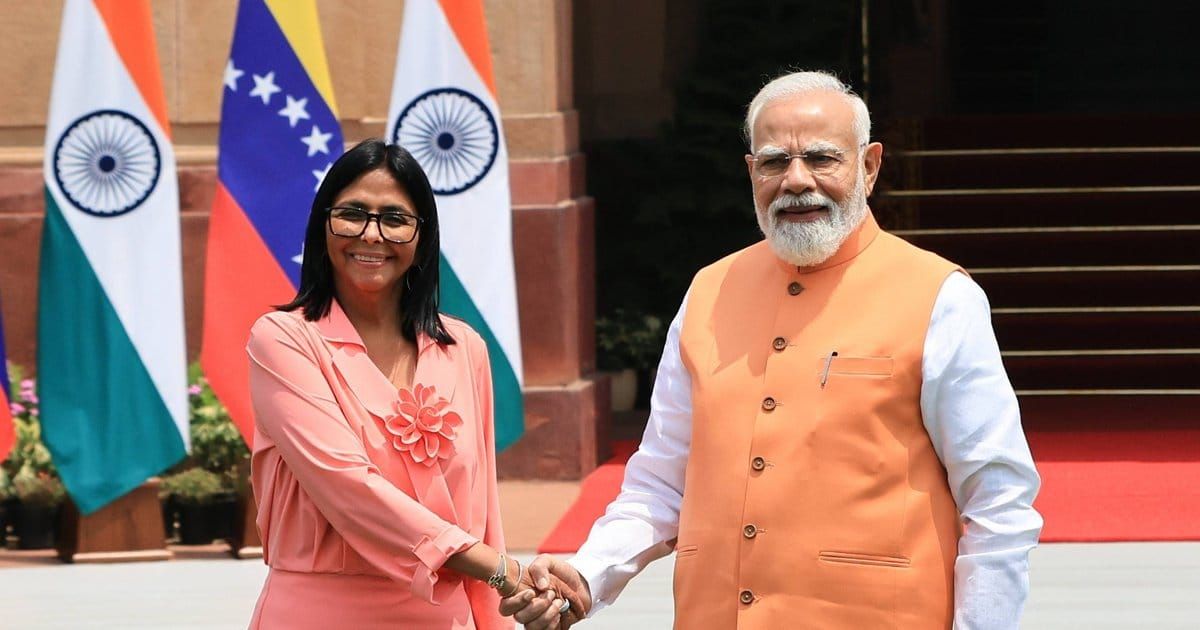
Acting President Delcy Rodríguez with Indian Prime Minister Narendra Modi at Hyderabad House, New Delhi, on June 4, 2026. Photo: Venezuelan Presidential Press.
Dek
Between June 3 and 7, Acting Head of State Delcy Rodríguez led a five-day mission to India focused on crude oil, refining, and renewable energy. India — Venezuela's second-largest oil export destination in May — called for "long-term complementarity" and opened the door to both its state-owned and private companies.
Multimedia
- 🎥 Official video (22 s) — Message from Delcy Rodríguez upon arrival in New Delhi: "We arrive in India with great joy…". Source: Venezuelan Presidential Press.
- 📸 Main photo — Delcy Rodríguez and Narendra Modi during the formal greeting at Hyderabad House (June 4, 2026). Source: Venezuelan Presidential Press.
Lead
Venezuela's Acting President Delcy Rodríguez concluded a five-day official visit to the Republic of India on Saturday, June 7, a trip in which oil was the central thread — but not the only one. Accompanied by a cabinet delegation that included Foreign Minister Yván Gil, Transport Minister Jacqueline Faría, Health Minister Isabel Iturria, and Science and Technology Minister Gabriela Jiménez, the Acting Head of State met on Thursday, June 4, with Indian Prime Minister Narendra Modi at Hyderabad House, toured the world's largest refinery — Reliance Industries' complex in Jamnagar — and held parallel working sessions with the Tata Group, the International Solar Alliance, and the Indian foreign ministry. The backdrop: India is already Venezuela's second-largest crude oil buyer and is looking to lock in barrels amid disruption in the Strait of Hormuz.
Historical context
The bilateral relationship between Caracas and New Delhi is not new. Before the United States imposed petroleum sanctions in 2019, Venezuela had been India's third-largest crude supplier in 2012 and remained among its main partners through the end of that decade. Maritime analytics firm Kpler documents that in 2018 Venezuela exported around 16 million tonnes of crude per year to India, with bilateral trade reaching $6.4 billion — sustained almost entirely by hydrocarbons.
Sanctions reshuffled those flows. Indian refineries — primarily Reliance Industries, a longstanding buyer of Venezuelan extra-heavy crude owing to its unique coking capabilities at Jamnagar — suspended direct purchases in 2019 and maintained a pause that stretched for years. Normalization began in February 2026, when Washington eased the sanctions regime and enabled Asian buyers to return in an orderly fashion to the Venezuelan market. April brought the first crude cargo to India after the hiatus: roughly 280,000 barrels per day, according to Kpler data cited by Bloomberg. By May the figure had climbed to 427,000 barrels per day according to a PDVSA report, while independent estimates put the range at 380,000–427,000 bpd. India thus became Venezuela's second-largest crude export destination for the month, behind only the United States (558,000 bpd) and ahead of Europe (169,000 bpd).
This was Rodríguez's sixth visit to India — following trips in 2015, 2019, 2023, 2024, and 2025 — and the first she has made as Acting President. The continuity of her personal ties with Indian authorities, and with the spiritual sanctuary of Prasanthi Nilayam in Andhra Pradesh, where Rodríguez has made pilgrimage on earlier visits, lent the summit a degree of familiarity unusual for this type of high-level encounter.
Hard data
May 2026 figures (source: PDVSA and Kpler):
- National production: 1.2 million barrels per day (La Radio del Sur, June 2, 2026).
- Official year-end 2026 target: 1.37 million barrels per day.
- Total May exports: 1.15 million bpd across 67 maritime shipments.
- Destinations: United States 558,000 bpd · India 427,000 bpd · Europe 169,000 bpd.
Venezuela's position in the Indian market:
- Fourth-largest crude supplier to India in May, behind Russia, the United Arab Emirates, and Saudi Arabia (Kpler via BBC Mundo).
- Indian Foreign Ministry Secretary Rudrendra Tandon stated during the visit that Venezuela "has already consolidated itself as India's third-largest crude supplier this month" (June).
- Kpler's June projection: arrivals above 300,000 bpd, with scenarios reaching up to 380,000 bpd.
Indian state enterprise cooperation:
- ONGC Videsh — the international arm of India's state oil and gas corporation — has held equity stakes in Venezuelan energy projects for more than a decade and is seeking to resolve accumulated dividends from the sanctions period (Infobae).
- Reliance Industries signed a framework agreement with PDVSA in 2012 for up to 400,000 bpd. That agreement was never formally cancelled — only suspended by sanctions. By May 2026, Reliance had become one of the three largest buyers of Venezuelan crude, taking direct cargoes and sourcing through intermediaries including Chevron, Vitol, and Trafigura (El Colombiano).
Box 1 · What both sides said after the bilateral meeting
Indian readout (MEA special briefing, June 4):
"The discussions focused on forging a long-term energy partnership. There is a perfect complementarity between India and Venezuela for working in the energy sector, both upstream and downstream. Venezuela sees India as a stable source of demand for many years to come — that is the foundation of sustained cooperation."
— Rudrendra Tandon, Secretary (East), Ministry of External Affairs (ANI, June 4, 2026).
"We are working with a government that is friendly and that wants a partnership with India. We want to reciprocate that sentiment. Venezuela has traditionally been a close friend. We are simply returning to normalcy."
— Rudrendra Tandon (Banca y Negocios, June 4, 2026).
Venezuelan readout (Presidential Press, official statements of June 3 and 4):
"We arrive in India with great joy, bearing Venezuela's message of peace, friendship, and cooperation. In this courageous, spiritual, and great economic power, we will fulfill a productive working agenda aimed at strengthening areas of cooperation for the benefit of our people — advancing along the path of complementarity and shared development between our nations."
— Delcy Rodríguez, official statement upon arrival at Palam Airport, New Delhi (June 3, 2026).
"It was an honor to meet Prime Minister Narendra Modi of India at Hyderabad House, to whom I expressed gratitude for his warm welcome and conveyed the greetings of the Venezuelan people. In this fraternal meeting, we addressed bilateral cooperation in the following areas: transport, health, energy complementarity, agriculture, science and technology — exploring new avenues for strategic partnerships in the interest of both our peoples. We reaffirmed our commitment to continue strengthening our relationship, in pursuit of a future of shared prosperity between our nations and for the Global South."
— Delcy Rodríguez, official statement following the meeting with Modi at Hyderabad House (June 4, 2026).
Key actors
On the Indian side, participants at various points during the visit included:
- Narendra Modi, Prime Minister. Bilateral meeting with working lunch at Hyderabad House on June 4.
- Subrahmanyam Jaishankar, Minister of External Affairs. Preliminary meeting with Rodríguez on June 4.
- Vikram Misri, Foreign Secretary.
- Rudrendra Tandon, MEA Secretary (East), technical spokesperson for the visit.
- Randhir Jaiswal, MEA spokesperson.
- Aman Puri, Joint Secretary and Head of the South America Division at the MEA, in charge of the reception protocol at Palam Airport.
On the Venezuelan side, the delegation comprised:
- Delcy Rodríguez, Acting President.
- Yván Gil, Minister of People's Power for Foreign Affairs.
- Jacqueline Faría, Minister of People's Power for Transport.
- Isabel Iturria, Minister of People's Power for Health and Sectoral Vice-President.
- Gabriela Jiménez, Minister of People's Power for Science and Technology, Director of the National Center for Cyber Defense and Security.
- Miguel Pérez Pirela, Sectoral Vice-President for Communication and Culture (Infobae).
- Capaya Rodríguez, Venezuelan Ambassador to India.
- Shri Ashok Babu, Indian Ambassador to Venezuela.
Indian corporate sector on the agenda:
- Reliance Industries (Jamnagar refinery, Gujarat — the world's largest refining complex, with a combined capacity of more than one million barrels per day).
- Tata Group (visit to headquarters in Mumbai).
- ONGC Videsh (international subsidiary of state-owned Oil and Natural Gas Corporation).
- Vantara, the Ambani family's large-scale animal conservation and species rescue project led by Anant Ambani — a protocol tour included in the itinerary (Diario Libre).
Multilateral bodies:
- International Solar Alliance (ISA), headquartered in Gurugram, to explore joint renewable energy projects.
Box 2 · India–Venezuela timeline, 2025–2026
| Date | Milestone |
|---|---|
| Feb 2025 | Delcy Rodríguez, then Vice-President with an energy portfolio, attends India Energy Week in Goa. |
| 2025 (full year) | India maintains a near-12-month pause on direct Venezuelan crude purchases due to the U.S. sanctions regime. |
| Jan 2026 | The Venezuelan executive is placed under Acting President Delcy Rodríguez. Normalization agreement with Washington opens the way for sanctions easing. |
| Feb 2026 | A supervised petroleum supply framework agreement is signed between Caracas and Washington. Indian refineries resume purchases. |
| Apr 2026 | First Venezuelan crude cargo arrives in India after the hiatus: 280,000 bpd — the highest level since March 2020. |
| May 2026 | Venezuela reaches 427,000 bpd to India (second-largest global destination, source: PDVSA). |
| Jun 3, 2026 | Rodríguez lands at Palam Airport, New Delhi. |
| Jun 4, 2026 | Bilateral meeting with Modi and Jaishankar at Hyderabad House. Wreath-laying ceremony at Rajghat, Mahatma Gandhi memorial. |
| Jun 5–7, 2026 | Parallel technical working sessions. Tour of the Reliance refinery in Jamnagar. Meetings in Mumbai with Tata and ONGC Videsh. Visit to Vantara. Meeting with the International Solar Alliance. |
What was discussed, what was announced, and what was not signed
Secretary Tandon was explicit in characterizing the nature of the meeting: "There were no formal energy agreements signed, naturally, because this level of meeting is not about agreements but about political direction" (Yahoo News / EFE). The signal sent by the Indian side, however, points to something more structural: a political mandate for Indian state-owned and private companies to expand their participation in Venezuela's oil sector — in both upstream (exploration and production) and downstream (refining, distribution, and marketing).
According to the MEA summary, the areas of convergence discussed were:
- Long-term energy partnership covering crude oil, natural gas, refining, marketing, and potentially exploration.
- Resolution of ONGC Videsh's outstanding dividends from its historical operations in Venezuela.
- Critical minerals, identified by India as a priority sector for diversification beyond oil.
- Pharmaceuticals and healthcare, where India is a global exporter and Venezuela a natural market.
- Agriculture, livestock, farm equipment, and MSMEs (micro, small, and medium enterprises) as low-barrier-to-entry pillars of cooperation.
- Automotive sector, potentially integrating Indian suppliers into Venezuela's vehicle assembly chains.
- Renewable energy, through the International Solar Alliance, with a focus on solar projects.
Spokesperson Randhir Jaiswal summarized the joint statement as follows: "Both leaders reaffirmed their commitment to deepen the bilateral partnership and advance the interests of the Global South" (NDTV Profit). The "Global South" framing is not decorative: it functions as a shared political framework for sustaining the relationship beyond the sanctions cycle.
Box 3 · What makes the Jamnagar refinery unique
Reliance Industries' refinery in Jamnagar, Gujarat, is no routine protocol stop. It is the world's largest oil refining complex, with a combined capacity of more than 1.24 million barrels per day across its two processing units. Its importance to Venezuela is technical before it is commercial:
- It is specifically engineered to process extra-heavy crude of the kind produced in the Orinoco Oil Belt, which requires deep coking capabilities that very few refineries in the world possess.
- Reliance signed a framework agreement with PDVSA in 2012 for up to 400,000 bpd. The agreement was never formally cancelled — only suspended by sanctions.
- In May 2026, Reliance consolidated its position as one of the three largest global buyers of Venezuelan crude, according to El Colombiano.
- Jamnagar's technical characteristics allow it to extract greater economic margin from Venezuelan grades than most Asian competitors, underpinning stable demand even without exceptional discounts.
Tensions and risks
The optimism of the joint communiqué does not conceal the sensitive pressure points in the relationship:
1. Supervised sanctions framework. Indian purchases of Venezuelan crude operate within the framework agreed in February 2026 between Caracas and Washington. Any change to that framework — expansion, restriction, or technical conditions — immediately alters the flow of barrels. Indian refineries have shown a willingness to operate under the scheme, but they require regulatory predictability.
2. ONGC Videsh's outstanding dividends. The Indian state company has accrued unpaid dividends from its Venezuelan operations during the years of heaviest sanctions. Resolving that liability is a precondition for new investment by the Indian state entity. No solution was announced during this visit.
3. Competition from other buyers. The United States leads Venezuelan crude imports (558,000 bpd in May), and the same cargoes are also flowing to Europe and other Asian destinations. The space for India to grow depends on PDVSA's actual capacity to lift production beyond the current 1.2 million bpd.
4. Maritime logistics. Ships sailing from Venezuela to India travel long, geopolitically exposed routes, including the current bottleneck in the Strait of Hormuz. India is seeking diversification precisely because of that exposure — but diversification itself requires reliable logistics infrastructure at the source.
5. PDVSA's technical capacity. The ramp-up to 1.37 million bpd by end-2026 — the official target — depends on new investment materializing and on coordinated operations with Chevron, Repsol, Eni, Maurel & Prom, and Reliance. The India visit is one piece of that broader puzzle.
Outlook: three indicators to watch over the next 90 days
1. June shipments to India. Kpler was already projecting arrivals above 300,000 bpd for the current month, with scenarios up to 380,000 bpd. The consolidated June figure will determine whether May's 427,000 bpd was a seasonal peak or a structural floor.
2. ONGC Videsh announcements. Any statement from the Indian corporation regarding investment in specific blocks in Venezuela — particularly in the Orinoco Oil Belt — will be the first concrete reading of the political shift that this visit has opened.
3. Indian attendance at India Energy Week 2027. If Venezuela returns at the highest level — whether with the Acting President herself or with Foreign Minister Yván Gil — it will signal that the long-term partnership declared in June is being institutionalized as a standing annual agenda.
Conclusion
The five-day visit produced two solid facts and one promise. The facts: Venezuela has just established itself, with verifiable data, as one of India's three largest crude suppliers so far in 2026; and Indian political leadership chose to treat the relationship as a long-term partnership rather than a transactional exchange. The promise: that Indian state-owned and private companies — Reliance, ONGC Videsh, Tata, and potentially others — will translate that political signal into actual investment within the next twelve months. Without that translation, what happened in New Delhi will remain a fine chapter in the diplomatic record. With it, it would mark Venezuela's full return to the global energy map of the South.
Sources
- Indian Ministry of External Affairs · Official press release on the visit (Jun 3–7, 2026)
- Indian Ministry of External Affairs · Transcript of special briefing (Jun 4, 2026)
- Venezuelan Presidential Press · Start of the visit (Jun 3, 2026)
- The New Indian Express · India and Venezuela agree on long-term energy partnership (Jun 4, 2026)
- ANI News · MEA: perfect complementarity for energy cooperation (Jun 4, 2026)
- NDTV Profit · Rodríguez meets Modi, reaffirms bilateral commitment (Jun 4, 2026)
- BBC Mundo · Why India is interested in Venezuelan oil (Jun 3, 2026)
- Bloomberg via Energy Connects · Visit framed by energy security concerns (Jun 3, 2026)
- Banca y Negocios · India is a preferred partner (Jun 4, 2026)
- El Colombiano · PDVSA export record in May 2026
- La Radio del Sur · Production reaches 1.2 million bpd
- Yahoo News / EFE · No formal agreements but the door is opened (Jun 4, 2026)
- Infobae · Landing in New Delhi (Jun 3, 2026)
- Diario Libre · Delegation to visit Reliance and Tata (Jun 2, 2026)
- CNN en Español · Opening diplomacy (Jun 3, 2026)
- Emol · The keys to renewed interest (Jun 4, 2026)
Caracas. VenezuelaExt. June 2026.
By: Javier Romero
Editorial direction: Javier "El Profe" Romero (Director) · Rosa Jiménez Cano (Co-director)