Caracas–Ankara: Delcy Rodríguez and Erdoğan agree to triple bilateral trade and convene the 5th Joint Commission
Meeting at Dolmabahçe Palace, a USD 3 billion bilateral trade target and a 5th Joint Commission in Venezuela in November. A nine-sector agenda that...
VenezuelaExt — June 9, 2026
By Javier "El Profe" Romero
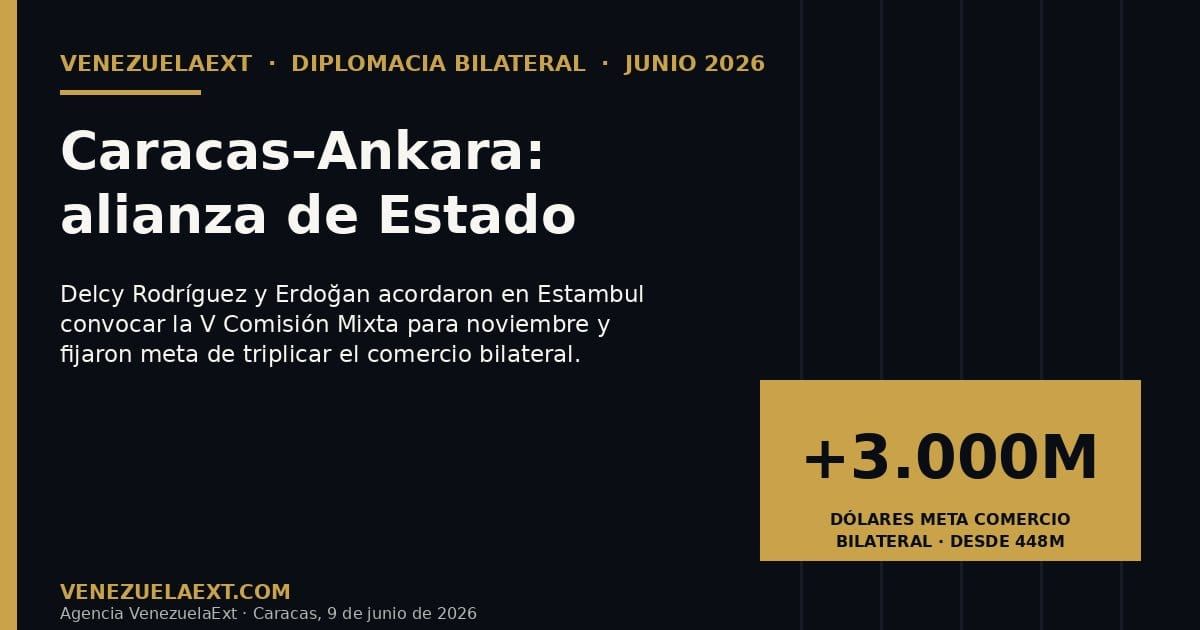
The Acting President of the Bolivarian Republic of Venezuela, Delcy Rodríguez, was received on Monday, June 8, at the Dolmabahçe Palace in Istanbul by the President of the Republic of Türkiye, Recep Tayyip Erdoğan. The meeting, lasting more than two hours, capped a decade of institution-building between Caracas and Ankara and opened a new cycle: both governments agreed to convene the 5th Joint Bilateral Cooperation Commission in November of this year in Venezuela, and set an explicit target to raise bilateral trade from the current USD 448 million to USD 3 billion, according to the official statement from the Turkish Presidency and confirmed by the Venezuelan leader herself in remarks to Venezolana de Televisión (Venezuelan Presidential Press, Banca y Negocios).
The Turkish leg, the second stage of an international tour that began in India, was not limited to the energy chapter. Rodríguez arrived in Istanbul accompanied by a deliberately multi-sectoral delegation: Foreign Minister Yván Gil; Sectoral Vice President for Science and Technology Gabriela Jiménez; Tourism Minister Daniella Cabello; Transport Minister Jacqueline Farías; Foreign Trade Minister Johann Álvarez; and Sectoral Vice President for Communications Miguel Pérez Pirela. The composition of the traveling cabinet foreshadowed the nature of the conversation: a state agenda where energy, while important, coexists with tourism, air transport, science, agro-industry, industry, health and housing (Infobae, Telesur).
KEY FIGURE: Caracas and Ankara set the goal of raising bilateral trade from USD 448 million (2025) to USD 3 billion, more than sextupling the current flow. The 5th Joint Cooperation Commission will be held in November 2026 in Venezuela, accompanied by an International Fair featuring Turkish companies. Source: Presidency of the Republic of Türkiye and official statements by Acting President Delcy Rodríguez.
A state relationship, not a moment of opportunity
The Dolmabahçe photograph condenses years of institutional work. Türkiye and Venezuela formally inscribed their rapprochement starting in 2016, when the foundations were laid for a bilateral agenda that would expand with reciprocal official visits, sectoral memoranda of understanding, and the creation of the Joint Cooperation Commission, the intergovernmental mechanism that has met on four occasions before the November date. In 2018, Erdoğan himself made an official visit to Caracas, a rare gesture for a Eurasian head of state in South America that, in protocol terms, marked the strategic character both capitals assign to the relationship (Infobae).
Since then, Delcy Rodríguez's visits to Türkiye in her capacity as Vice President —resumed in 2020— became one of the operational pivots of the relationship: each stop left signed sectoral agreements, new roadmaps or the reactivation of paused chapters. The current visit picks up that continuity and updates it to the 2026 cycle: an agenda that no longer needs to be introduced but deepened, as Rodríguez herself noted in her message posted on the official Telegram account after the meeting with Erdoğan: "It has been an honor to hold a fraternal and cordial working meeting with President Erdogan, where we addressed our joint cooperation in the areas of energy, transport, mining, air connectivity, science and technology, industry, electricity, and trade" (Ciudad CCS).
The core of the meeting: trade, tourism and connectivity
The statement from the Turkish Presidency, published hours after the meeting, identifies with precision the five priorities of the exchange: trade, investment, energy, mining and industry. To that list, the Venezuelan reading adds four additional components that reflect the diversification sought by Caracas: housing, infrastructure, health, and air connectivity (Mazo4F).
Air connectivity occupied a central place. Turkish Airlines, which has operated direct Istanbul–Caracas flights since 2016, has consolidated itself as one of the main intercontinental connections of Maiquetía International Airport. "Turkish Airlines has become one of the main airlines flying to Venezuela," Rodríguez emphasized at the end of the day (EFE). Tourism Minister Daniella Cabello, present in the delegation, held technical meetings with Turkish authorities to articulate cross-promotion of destinations and the opening of binational tourist information offices, in a chapter both governments consider key to diversifying the flow of foreign exchange.
The trade component, however, set the headline. The gap between the USD 448 million of 2025 and the target of USD 3 billion implies more than sextupling the flow in less than five years. The current figure breaks down into USD 251 million in Turkish imports from Venezuela —mostly oil and mining products— and USD 197 million in Turkish exports to the South American country, mainly food, milling products, mineral fuels and consumer manufactures (ABC Color).
Agro-industry, science and the new productive matrix
One of the less visible chapters of the meeting, yet strategically more relevant in the medium term, is agro-industrial cooperation. Türkiye has developed a globally competitive food processing industry —from flours and oils to milling and packaging technology— and Venezuela is seeking to leverage that know-how to strengthen domestic productive links in sectors such as fine aroma cacao, coffee, tropical fruits, dairy and animal protein. The inclusion of Sectoral Vice President for Science and Technology Gabriela Jiménez in the delegation points precisely to this crossover: applied technology transfer to productive chains with export potential.
KEY FIGURE: The Venezuelan delegation included seven ministers and sectoral vice presidents representing Foreign Affairs, Foreign Trade, Tourism, Science and Technology, Transport and Communications. The composition reflects the bet on a multi-sector agenda rather than a single-issue one. Source: Venezuelan Presidential Press and Telesur.
Transport Minister Jacqueline Farías, in turn, articulated a specific table on cooperation in railway and port infrastructure. Türkiye is today one of the world's leading builders of transport infrastructure, with companies operating in more than 80 countries. The possibility of incorporating Turkish capabilities into Venezuelan port modernization and overland connectivity projects is among the topics that will be deepened in November's Joint Commission.
The shared declaration: trade and sovereignty
The cross-statements between both leaders articulate two complementary discursive floors. On the Turkish side, Erdoğan reaffirmed that "Türkiye will always stand by the friendly people of Venezuela" and described bilateral cooperation as a "multidimensional" agenda to deepen. On the Venezuelan side, Rodríguez framed the trip as an expression of the Bolivarian diplomacy of peace and emphasized that Venezuela's economic development is advancing "after consolidating important agreements aimed at diversifying the economy before the world, not only as an energy power with vast reserves, but as a Nation with full potential in key areas" (Contrapunto).
The formula is deliberate. The Acting President used the trip to Türkiye not to frame a tactical alliance but to underscore institutional continuity: a state agenda where the bilateral is built on formal intergovernmental structures —the Joint Commission, sectoral memoranda, reciprocal high-level visits— and not on circumstances. That same logic projected itself in the presence of Turkish Vice President Cevdet Yılmaz, Foreign Minister Hakan Fidan, Energy and Natural Resources Minister Alparslan Bayraktar, Industry and Technology Minister Mehmet Fatih Kacır and Trade Minister Ömer Bolat in the delegation talks. Five Turkish ministries of the highest rank seated at the table, facing an equally robust Venezuelan delegation (Noticias Venevisión).
The Joint Commission as roadmap
The most important operational announcement of June 8 was the convening of the 5th Joint Bilateral Cooperation Commission for November, this time on Venezuelan soil. The Joint Commission is the main institutional instrument that articulates cooperation between both countries: it brings together technical and political delegations to review the status of compliance with existing agreements, identify new sectors of joint work, and sign legal instruments that give continuity to the relationship beyond political cycles. Its fifth edition, in Caracas, will arrive accompanied by an International Fair with Turkish companies meeting their Venezuelan counterparts.
KEY FIGURE: The 5th Joint Commission will take place in November 2026 in Venezuela, accompanied by a Türkiye–Venezuela International Fair featuring Turkish companies. The meeting will function as the operational space where the political guidelines defined in Istanbul will translate into concrete agreements. Source: official statements by Acting President Delcy Rodríguez on VTV.
The choice of format is not trivial. A binational fair with companies present —and not just government delegations— shifts the cooperation exercise from the plane of political will to the plane of commercial contracts. Caracas and Ankara agree that the current USD 448 million of trade is well below the real potential, and that only through a direct encounter of productive actors will it be possible to identify the niches where trade can grow by orders of magnitude.
The tour in perspective: India, Türkiye and multidimensional diplomacy
The trip to Türkiye is part of a broader international tour that previously took Rodríguez to New Delhi for five days. There, the Acting President held meetings with Indian Prime Minister Narendra Modi and articulated an equally diversified agenda: energy, health, public transport, science and technology, energy complementarity and renewable energies (Infobae).
The continuity between New Delhi and Istanbul is not coincidental. Both capitals represent, on the current geoeconomic map, two relevant poles of an international order in transition: emerging economies with their own weight, installed industrial capacity, and a vocation for strategic autonomy that makes them natural interlocutors for a Venezuela that vindicates the diversification of its international relations. The sequential India–Türkiye choice thus draws an arc of Eurasian cooperation where Caracas inserts itself not as a peripheral actor but as a partner with its own assets: energy and mineral reserves, strategic geographic position in the Caribbean, productive capacity in sectors such as agro-industry, pharmaceuticals and consumer manufactures, and a relevant domestic market for the exports of extra-regional partners.
The energy component, in its proper dimension
Energy cooperation remains, naturally, one of the central chapters of the Caracas–Ankara relationship, but the Venezuelan institutional reading has been careful in this trip not to present it as the sole axis. The memoranda signed in 2024 between the energy ministries of both countries cover oil, natural gas, and mining, and constitute the basis on which the next steps are projected. The eventual expansion of these instruments —in strict compliance with the international regulatory framework— is part of the technical conversations that will be deepened at the November Joint Commission.
Turkish Energy and Natural Resources Minister Alparslan Bayraktar personally received the Venezuelan delegation upon arrival in Istanbul and held a bilateral meeting prior to the encounter with Erdoğan. The conversation, according to Telesur, served to "significantly expand the existing development agreements and pave the way for the signing of new sovereign commercial agreements" (Telesur). The emphasis on sovereignty is central: Caracas has been articulating a model of international cooperation where agreements are signed between States and executed respecting the national legal frameworks of each party, without external conditioning.
KEY FIGURE: The June 8 agenda included nine priority sectors: energy, transport, mining, air connectivity, science and technology, industry, electricity, trade, and housing/infrastructure. This diversification is deliberate and reflects the bet on a multidimensional relationship between Caracas and Ankara. Source: official statement by Acting President Delcy Rodríguez on Telegram.
A medium-term reading
What, ultimately, does the June 8 day in Istanbul leave behind? Three main readings stand out.
First, the institutional consolidation of a state relationship. The Dolmabahçe meeting did not inaugurate anything: it continued a conversation opened a decade ago and updated it to the 2026 cycle. The 5th Joint Commission is the concrete tool for that update, and the fixed calendar —November, in Venezuela— gives predictability to the process.
Second, the deliberate sectoral diversification. Caracas carefully avoids presenting the relationship with Ankara as a single-issue alliance. The nine areas mentioned in the official Venezuelan declaration, the plural composition of the delegation that traveled, and the explicit inclusion of chapters such as tourism, science, and agro-industry configure a clear message: Venezuela seeks to project itself internationally not only as an exporter of resources but as an economy with potential in multiple sectors.
Third, the quantitative target of USD 3 billion in bilateral trade functions as a compass. It is ambitious —it implies more than sextupling the current flow— but not implausible: both countries have demonstrated the capacity to scale sectoral agreements in short periods when political will and institutional devices exist to sustain the process. The Joint Commission and the November International Fair will be the first tests of the real commitment to that goal.
Türkiye and Venezuela close June 2026 with a clear roadmap, fixed schedules, identified priority sectors, and above all, a solid institutional architecture on which to build. The next chapter will be written in Caracas.
Javier "El Profe" Romero
VenezuelaExt
Caracas, June 9, 2026
Sources
- Venezuelan Presidential Press — official statement June 8, 2026
- Telesur — strategic cooperation coverage
- Banca y Negocios — 5th Joint Commission
- Infobae América (EFE) — USD 3 billion target
- Infobae Venezuela — bilateral analysis
- Contrapunto — economic development statements
- Noticias Venevisión — delegation composition
- Mazo4F (CEMD) — Dolmabahçe agenda
- Ciudad CCS — Rodríguez Telegram statement
- ABC Color — trade breakdown
- EFE — tour closure and air connectivity
- Infobae América (EFE) arrival — Istanbul arrival and delegation