Chevron 2050: the long-horizon agreement that anchors US capital in Venezuelan oil
Caracas and Chevron signed an unprecedented long-term operating framework that extends US investment in Venezuelan crude through mid-century.
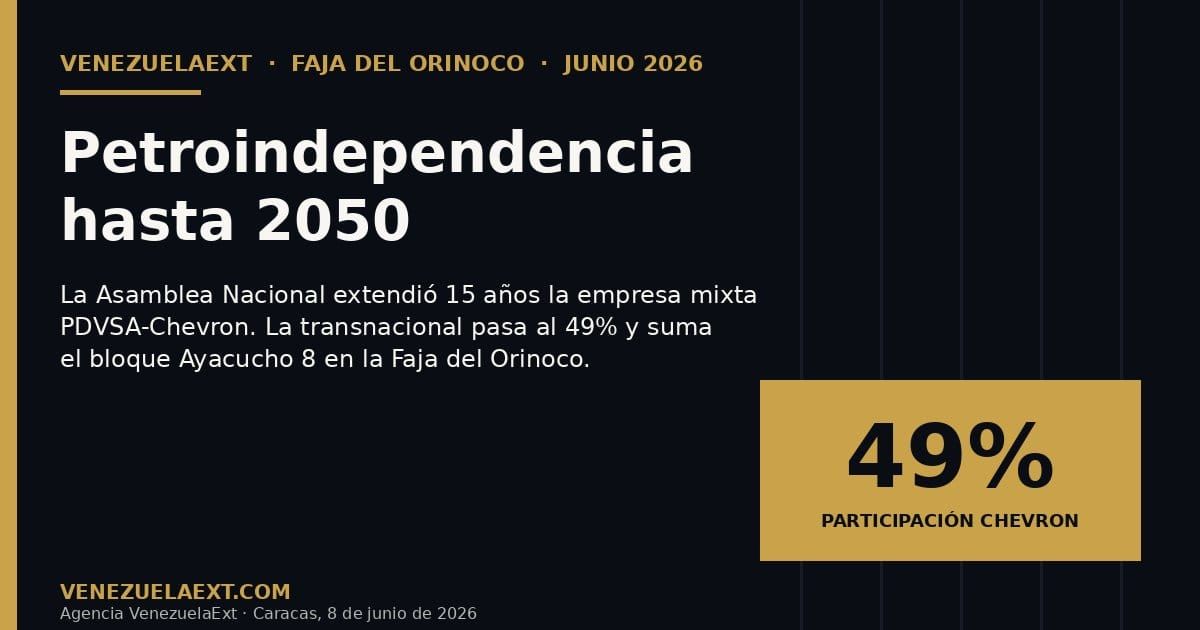
Dek — The joint venture between PDVSA and U.S.-based Chevron will operate 15 years beyond its original term. The American firm's stake rises from 34% to 49% and it gains rights over the Ayacucho 8 block. This is the keystone of Venezuela's new oil cycle.
Caracas — June 8, 2026. By Javier Romero.
The Orinoco Oil Belt — 303 billion barrels of proven reserves, the largest crude accumulation on the planet — is once again the center of gravity of the continental energy conversation. And it is so for a concrete reason: Petroindependencia, the joint venture operating in the Carabobo block between Petróleos de Venezuela S.A. (PDVSA) and U.S.-based Chevron, now has guaranteed operational continuity through 2050, after Venezuela's National Assembly unanimously approved a 15-year extension to the original contract that was set to expire in 2035 (National Assembly).
That institutional decision was followed, two years later, by a package of agreements signed on April 13, 2026 at Miraflores Palace between acting President Delcy Rodríguez, PDVSA's leadership and Chevron Venezuela's senior management. The agreements raise Chevron's equity stake in Petroindependencia from 34% to 49% and grant it exploitation rights over a new block, Ayacucho 8, which is now integrated into the production scheme of the Petropiar joint venture (Banca y Negocios; Xinhua).
The bottom line: the U.S. transnational is now anchored in Venezuela through the middle of the 21st century in one of the largest extra-heavy oil projects in the world, while the Venezuelan State retains majority control and advances its official strategy of reactivating the hydrocarbons sector.
Where we come from: a joint venture born under Chávez
Petroindependencia is not a creation of circumstance. It was constituted in 2010, under the presidency of Hugo Chávez, as a corporation between PDVSA and private partners, with an initial operating term of 25 years (Panorama). Its mission: to develop the Carabobo block in the Orinoco Belt, an extra-heavy crude region considered strategic for the magnitude of its reserves.
The original equity structure set 60% for Corporación Venezolana de Petróleo (CVP) — PDVSA's wholly state-owned subsidiary — and 40% distributed among private partners: Chevron Carabobo Holding ApS, Japan Carabobo Ltd (the Inpex-Mitsubishi-JOGMEC consortium) and Venezuelan firm Suelopetrol (Wikipedia / Orinoco Belt).
That structure — majority state, minority private — is the joint venture model that has governed Venezuela's entire oil sector since the Organic Hydrocarbons Law. Under the same logic operate Petropiar (PDVSA + Chevron), Petroboscán (PDVSA + Chevron) and other joint ventures in the Belt and in Zulia.
What has changed in this cycle is the depth of the foreign capital commitment, the regulatory framework enabling it, and the time horizon of the operation.
The first milestone: the parliamentary extension to 2050
On July 17, 2024, the National Assembly unanimously approved the 15-year extension to Petroindependencia's contract. Deputy Ángel Rodríguez (PSUV/Anzoátegui) explained during the debate that the decision was part of the process of renewing the joint ventures and recalled that this structure had been "designed by President Hugo Chávez" (National Assembly).
The session included concrete production data. Deputy Carlyana Arriechi (CMC/National) specified that Petroindependencia was operating at the time with a production of 17,800 barrels per day, with official targets of 110,000 b/d for 2025 and 200,000 b/d for 2027.
The approval also incorporated a reform of Article 2 of the constitution decree, which establishes that shareholders are not exempt from the bonus payment they owe to the Republic for crude exploitation. In other words: the extension of the time horizon came accompanied by a fiscal clarification in favor of the Venezuelan State.
BOX 1 — Petroindependencia in numbersOriginal constitution: 2010 (Hugo Chávez administration)Initial term: 25 years (expiring 2035)Extension approved by the National Assembly: 15 additional yearsNew expiration date: 2050Approval: July 17, 2024, unanimousEquity structure 2010-2026: 60% CVP / 34% Chevron / 5% Japan Carabobo / 1% SuelopetrolNew structure 2026: 51% CVP / 49% Chevron (post-April 13 agreement)Production 2024: 17,800 b/dOfficial target 2025: 110,000 b/dOfficial target 2027: 200,000 b/d
Sources: National Assembly, La Verdad, Petroguia.
The second milestone: the April 13, 2026 agreements
Two years after the parliamentary extension, the international regulatory landscape shifted. Between January and March 2026, the Office of Foreign Assets Control (OFAC) at the U.S. Department of the Treasury issued a package of general licenses — 46, 46A, 46B, 48, 48A, 49, 49A and 50 — enabling U.S. and European companies to carry out specific operations in the Venezuelan oil sector (Misión Verdad).
License 50 specifically regulates the participation of the major international energy companies — Chevron, BP, Eni, Repsol — in the purchase of Venezuelan oil and gas under defined operational conditions. This legal coverage opened the door to the formalization of the new Caracas agreements.
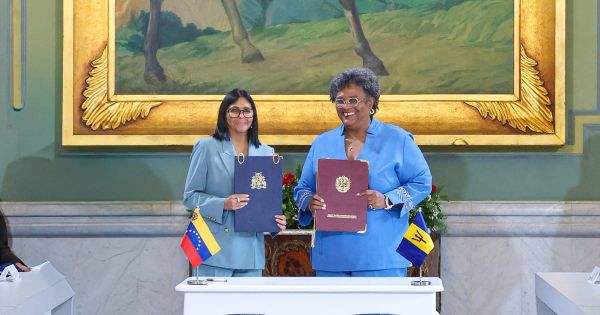
On April 13, 2026, at Miraflores Palace, acting President Delcy Rodríguez led the signing ceremony. Representing Chevron were Chevron Venezuela president Mariano Vela and Commercial Vice President Mario Gandara. Javier La Rosa signed for operational representation. Also present were U.S. officials, including Kyle Haustveit, U.S. Under Secretary for Fossil Energy and Carbon Management at the Department of Energy (Orinoco Tribune).
The agreements cover three concrete points:
- Increase in Chevron's equity stake in Petroindependencia from 34% to 49% (Infobae).
- Award of the Ayacucho 8 block — located in the Orinoco Belt, considered strategic for its extra-heavy crude reserves — to the Petropiar joint venture, where Chevron also holds participation.
- Asset swap: Chevron returns to the State its stake in an offshore gas field and a small western field, which will be operated by Shell, according to sources cited by Reuters.
The companies signing the agreement, per the official report, include PDVSA, CVP, Petropiar S.A., Petroindependencia, Petroindependiente S.A., Chevron Orinoco Holdings B.V., Chevron Carabobo Holding ApS, Chevron Lago de Maracaibo and Chevron Global Technology Services Company (Xinhua).
Acting President Delcy Rodríguez summarized the spirit of the agreement during the signing: "I take this opportunity to reiterate that we must move toward a Venezuela without sanctions, always" (Orinoco Tribune).
The productive present: 260,000 barrels per day and rising
The joint ventures operated jointly by PDVSA and Chevron currently produce around 260,000 barrels per day of crude, equivalent to approximately 25% of Venezuela's national production (Infobae). In May 2026, Chevron specifically moved 269,000 b/d toward export, according to the monthly balance published by VenezuelaExt (Banca y Negocios).
The target stated by Chevron's leadership is to increase production by 50% over the next two years, leveraging the easing of the international regulatory framework and the Executive's openness to foreign investment under the new Organic Hydrocarbons Law.
If that target is met, the PDVSA-Chevron projects would move from today's 260,000 b/d to approximately 390,000 b/d by mid-2028, consolidating Chevron as the leading international operator in Venezuelan territory and the Orinoco Belt as the most active block in the productive recovery.
BOX 2 — Map of Chevron-PDVSA joint ventures
Current aggregated production: ~260,000 b/d (25% of national total).
Sources: Infobae, Servindi.
Regulatory framework: the new Hydrocarbons Law and License 50
The entire operation rests on two intertwined legal pillars: the Venezuelan domestic framework and the U.S. regulatory framework.
On the domestic level, the new Venezuelan Hydrocarbons Law — explicitly referenced by Chevron's representative, Javier La Rosa, during the April 13 signing — sets the regime under which joint ventures can expand operations, receive new exploitation blocks and access asset-swap schemes (Banca y Negocios). The law preserves the constitutional status of the State as owner of the natural resource and maintains the principle of PDVSA's majority participation in all joint ventures.
On the international level, OFAC licenses operate as specific authorization for U.S. entities to participate in operations. General License 46 enables activities of extraction, export, transport, refining, marketing and resale of Venezuelan crude. License 46A broadens the framework to include direct operations with PDVSA. License 50 specifically regulates the participation of Chevron, BP, Eni, Repsol and Shell in purchases and operations under conditions defined by the U.S. Treasury (Misión Verdad).
The result is a hybrid scheme in which Venezuelan institutionality — National Assembly, Ministry of People's Power for Hydrocarbons, PDVSA, CVP — coexists with U.S. financial regulation. This is the legal architecture that allows an agreement signed at Miraflores on April 13 to produce measurable commercial effects in May, with shipments to refineries on the U.S. Gulf Coast.
What is at stake: capital, technology transfer and certainty
The extension of the operational horizon to 2050 is not an administrative detail. It is a signal of regulatory stability that changes Chevron's investment calculus — and, by extension, that of other international energy companies studying deeper operations in Venezuela.
A joint venture expiring in 2035 faced a 9-year amortization horizon for new capital investments. With expiration in 2050, that horizon expands to 24 years, which enables substantially larger investment decisions in infrastructure, drilling, enhanced recovery technology and processing plant modernization.
To this is added the technology transfer component. Chevron Global Technology Services Company — one of the entities signing the April agreement — is the group's division providing extra-heavy crude processing technology, where the company holds patents and operational experience in Venezuela, Canada and California. For PDVSA, maintaining continued access to that technological capability is a measurable strategic value.
BOX 3 — Institutional timeline 2024-2026Jul 17, 2024: National Assembly approves 15-year extension for Petroindependencia (through 2050)Jan 29, 2026: OFAC issues General License 46 (Venezuelan oil activities)Early Feb 2026: OFAC issues License 46A (direct operations with PDVSA)Mar 13, 2026: OFAC issues package 46B, 48A, 49A (petrochemical products and derivatives)Mar 2026: OFAC issues License 50 (Chevron, BP, Eni, Repsol participation)Apr 13, 2026: Agreements signed at Miraflores; Chevron rises to 49% in Petroindependencia; Ayacucho 8 block to PetropiarMay 2026: Venezuela exports 1.25M b/d; Chevron moves 269,000 b/dJune 2026: Operational continuity secured through 2050
Sources: National Assembly, Misión Verdad, Banca y Negocios.
Official voices and the Executive's reading
Acting President Delcy Rodríguez has framed the agreements within the official strategy of national productive reactivation. At the April 13 ceremony she defined the signing as part of the process of normalizing international economic relations and reiterated the government's goal of advancing toward a sanctions-free scenario on a permanent basis.
The official framing emphasizes three dimensions:
- Sovereignty over the resource: the Venezuelan State retains majority control in Petroindependencia (51%) and in all joint ventures, in compliance with the constitutional framework.
- Productive reactivation with strategic partners: the opening to international capital is framed within the new Hydrocarbons Law, which defines the rules, percentages and fiscal control schemes.
- Social benefit: resources generated by oil activity are channeled toward State social programs, in line with the institutional formula in force since the creation of the National Development Fund.
Specific sector authority falls to the Ministry of People's Power for Hydrocarbons, which leads joint-venture policy and oversees commitments on investment, production and bonus payments.
Projection: toward the 2050 horizon
What changes with this architecture? Three indicators will be observable over the next 90 to 180 days:
First, the pace of effective investment. The April agreements open the possibility of Chevron capital commitments that were not feasible under the previous regime. The signal to watch is announcements of specific investment in drilling Ayacucho 8 and in expanding capacity in the Carabobo block.
Second, Petroindependencia's production trajectory. The official 2027 target is 200,000 b/d. If the ramp-up accelerates due to Chevron's new equity stake and the Ayacucho 8 synergy, that number could be revised upward.
Third, the incorporation of new partners. The Petroindependencia-through-2050 scheme is a reference model. Ongoing negotiations with BP, Eni, Repsol and Shell — already formalized or in memorandum-of-understanding phase — follow similar logics: extended horizon, asset swaps, framework under Venezuelan Hydrocarbons Law and OFAC coverage.
BOX 4 — What's coming in 90 daysJune-August 2026: announcements of specific Chevron investment in Ayacucho 8 and Carabobo blockJuly 2026: quarterly Petroindependencia production update (interim target: 60,000 b/d)August 2026: OPEC balance of Venezuelan production for July (projected: 1.28M b/d)September 2026: potential new agreements with BP, Eni, Repsol and Shell under replicable schemeOctober 2026: OFAC review of License 50 (8-month evaluation clause)
Sources: Energy Chamber, Transparencia Venezuela.
Closing
The extension of Petroindependencia through 2050 is the most visible piece of a new cycle. This is not a return to the past: it is the institutional construction of a long-term productive horizon, with clear rules, preserved state majority and international private partners with legal coverage in both hemispheres. The Orinoco Belt becomes once again, after years of regulatory tension, what its geology has always indicated: the most stable and predictable oil bet South America has for the next two decades.
Sources
- National Assembly of Venezuela — Petroindependencia Extension
- Banca y Negocios — Chevron signs agreement with PDVSA (April 2026)
- Xinhua — PDVSA-Chevron Agreements at Miraflores
- Infobae — Chevron expands operations in Venezuela
- Orinoco Tribune — Venezuela Signs Agreements With Transnational Oil Corporations
- Misión Verdad — Scope of OFAC licenses 2026
- La Verdad — AN 2020 extends Petroindependencia through 2050
- Petroguia — Petro Independencia extension through 2050
- Servindi — Chevron and PDVSA to extract oil in the Belt
- Wikipedia — Orinoco Oil Belt
- Energy Chamber — Venezuela under Rodríguez
- Transparencia Venezuela — PDVSA and the new oil order
- Venezuelanalysis — Rodríguez Signs Chevron Deals
- Banca y Negocios — Chevron production May 2026
Javier Romero — Director, VenezuelaExt News Agency · Caracas, June 8, 2026.