Power-sector opening: Venezuela invites private capital into electricity generation
The Acting Presidency announces a regulatory package that opens electricity generation and distribution to private investors, with a regional grid integration roadmap.
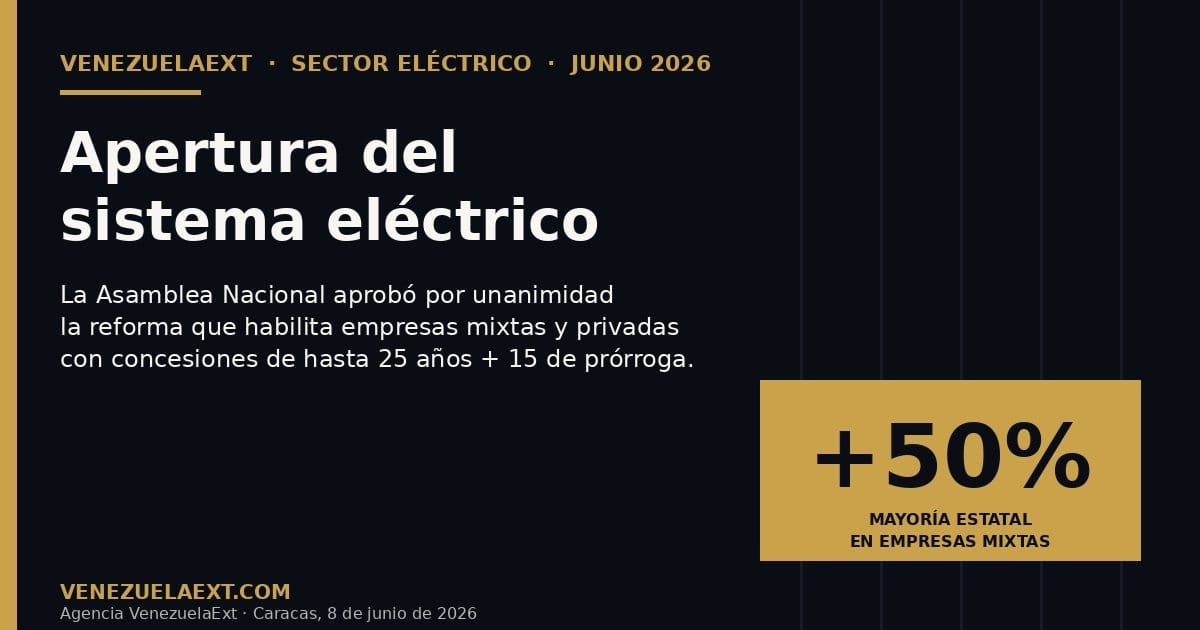
Lead — The National Assembly unanimously approved on first reading the bill submitted by acting president Delcy Rodríguez. The law enables joint ventures and private operators in generation, transmission, distribution and retail, with the State retaining more than 50% of each mixed company and a tariff scheme designed to sustain investment without sacrificing social coverage.
Caracas — June 8, 2026. By Javier Romero.
On Tuesday, June 2, 2026, the National Assembly unanimously approved on first reading the Organic Bill for the Partial Reform of the Organic Law of the Electricity System and Service, submitted by acting president Delcy Rodríguez (National Assembly; El Diario). The reform — comprising 42 articles — enables for the first time in 15 years the participation of joint ventures and private operators across the entire electricity service chain, under a concession regime of up to 25 years renewable for an additional 15 years.
The core of the reform was summarized by Deputy Orlando Miranda (PSUV/Lara), in charge of presenting the bill before the plenary: "the law contemplates the participation of the Venezuelan State as a fundamental factor that opens the door to mixed companies in which the Republic preserves control with more than 50% of share capital" (National Assembly). It is the same formula that has governed Venezuela's hydrocarbons sector since the Organic Hydrocarbons Law: state majority preserved, private partners with legal coverage, constitutional framework respected.
The unanimous vote turned the electricity reform into the second major structural move by the national Executive in 2026, following the April 13 PDVSA-Chevron agreements and the extension of Petroindependencia to 2050. If the oil sector recovered long-term productive horizon, the electricity sector now recovers institutional architecture for private investment with public control.
The diagnosis driving the reform
For 15 years, Corporación Eléctrica Nacional (Corpoelec) operated as the sole entity responsible for generation, transmission, distribution and retail of the electricity service, following the 2007 merger that centralized in a single corporation the former Cadafe, Edelca, Enelven, Enelco, Enelbar and Seneca, among others.
Deputy Miranda explained before the plenary that several thermoelectric plants remain shut down due to difficulties in obtaining spare parts, increasing dependency on the Guri Hydroelectric Central in Bolívar state. That concentration — Guri historically supplies close to 62% of installed generation — leaves the system exposed to hydrological risk and to interruptions from maintenance work (El Diario).
The reform therefore proposes three core pillars, as stated by the rapporteur in session:
- Protection of the national electricity system as a strategic State asset.
- Comprehensive infrastructure maintenance, with civil and criminal co-responsibility for operators.
- Optimization of service for the people, with mandatory economic compensation for damages caused by blackouts or supply quality deficiencies (National Assembly).
BOX 1 — What changes with the reform
Sources: National Assembly, Banca y Negocios, People's Daily.
The operating scheme: concessions, joint ventures and reasonable return
The reform's architecture is organized around four legal figures that coexist within the same National Electricity System (SEN):
First, the Venezuelan State as guiding actor, with ownership of strategic assets — Guri and the Lower Caroní complex, major national transmission trunks, dispatch — and as regulatory authority through the Ministry of People's Power for Electric Energy.
Second, joint ventures in which the Venezuelan Republic retains more than 50% of share capital, ensuring majority control in line with the constitutional framework. Under this figure, idle thermoelectric plants could be reactivated, mid-size hydroelectric facilities modernized, and installed capacity expanded in specific regions.
Third, companies with minority state participation, an intermediate scheme that allows more agile partnerships for specific projects where the State's contribution operates as institutional backing without the need for majority control.
Fourth, authorized private operators, enabled to participate in generation, distribution and retail under concession from the Ministry of Electric Energy, with a duration of up to 25 years, renewable for an additional 15 (Banca y Negocios).
The economic viability of the scheme rests on a tariff system designed to reflect the real cost of service and to offer reasonable return to operators, linked to efficiency criteria (El Diario). It is the end of the generalized subsidy regime that, for years, made any sustained infrastructure investment financially unviable.
BOX 2 — The concession regimeMaximum initial term: 25 yearsExtension: up to 15 additional years (total potential: 40 years)Granting authority: Ministry of People's Power for Electric EnergyEnabled areas: generation, transmission, distribution and retailOversight: State retains audit and revocation authorityRevocation grounds: failure to meet obligations, severe service failures, conditions defined in the lawCo-responsibility: civil and criminal liability for operating companiesModality: mixed capital (state majority) or private
Source: National Assembly.
The social component: blackout compensation and operational decentralization
One of the most relevant innovations of the reform — and one that rarely appears in similar frameworks across the region — is the legal obligation to economically compensate users for damages caused by blackouts or supply quality deficiencies. The obligation falls on distribution and retail companies, whether state-owned, mixed or private.
Deputy Miranda put it before the plenary: "distribution and retail companies will be legally obligated to economically compensate users for damages caused by blackouts or supply quality deficiencies" (National Assembly).
This clause represents a concrete institutional advance: it shifts to the service operator the responsibility for supply quality and creates a direct compensation mechanism for affected users. In practice, it aligns the concessionaire's economic incentives with the quality of service delivered.
To this is added the operational decentralization of Corpoelec, set forth in the reform draft as a way to bring the technical management of the service closer to the country's regional realities (El País). The corporation ceases to be the sole operator and becomes one actor among others in the system, while preserving its strategic role over the main assets — Guri and the national trunk — while specific zones may pass to mixed or private operators according to concessions granted by the Ministry.
The explicit priority: renewable energy
The reform incorporates the drive for renewable energy as a strategic axis, with declared priority on developing solar and wind sources as part of an energy diversification strategy (People's Daily).
This decision carries several converging readings:
Geographic: Venezuela has one of the largest solar potentials in South America in its coastal and plains zones, plus wind potential on the Paraguaná peninsula and in the Los Roques archipelago. These resources are underused in the current generation mix.
Economic: Renewables have declining capital costs across the continent. For a sector that needs to rapidly expand capacity, utility-scale photovoltaic solar offers construction times of 12 to 18 months versus the 3 to 5 years of a combined-cycle thermal plant.
Diplomatic: Renewables are the preferred investment line for European and Asian flows. Enabling this segment facilitates the incorporation of operators that diversify Venezuela's base of strategic partners beyond the oil axis.
Operational: Diversification reduces the system's dependency on Guri and the major thermoelectric plants, distributing risk and adding dispatch flexibility.
Constitutional framework: article 156
The legal pillar that sustains the entire reform is article 156 of the Constitution of the Bolivarian Republic of Venezuela, explicitly cited by rapporteur Orlando Miranda during the presentation of the bill in plenary (YouTube / National Assembly session June 2).
That article establishes the competence of National Public Power over the regime of administration, conservation and rescue of natural resources and strategic services, within which the electricity system has historically been included. The reform thus anchors in a pre-existing constitutional power, without requiring deep constitutional reform: it operates within the current framework, not against it.
This is consistent with the editorial line sustained by the Executive of Delcy Rodríguez: institutional renewal with preservation of the Bolivarian constitutional framework. The changes are substantive but the underlying legal architecture is preserved.
BOX 3 — The official argumentative line
Three discursive axes repeated during the June 2 session:"Modern, mixed, self-sustainable and responsible electricity system" — Deputy Orlando Miranda (PSUV/Lara), bill rapporteur."Rigorous regime of concessions, public oversight and civil and criminal co-responsibility" — official characterization of the proposed regime."The Republic preserves control with more than 50% of share capital" — formula ratifying the principle of state majority in mixed companies.
Source: National Assembly.
The piece still to come: the second reading
The reform was approved on first reading and by unanimity, implying full consensus of the legislative body. However, the second reading and definitive ratification remain pending, expected in the coming days (Mercopress).
Between first and second reading, the bill enters public consultation, the stage in which social organizations, business associations, technical academies and citizenry may submit observations on the 42 articles of the text (People's Daily). This phase typically incorporates relevant technical adjustments — especially on tariff regimes and concession terms — before the definitive vote in plenary.
If the calendar holds as foreseen by the Permanent Commission on Energy, the second reading could take place in the second half of June, with a view to definitive sanction before the close of the first legislative semester.
Operating context: Corpoelec in motion
The legislative reform is not an isolated act. The electricity system is already showing operating signals of motion. On June 6, 2026, Corpoelec announced the reactivation of Unit No. 3 of the Termocarabobo Thermoelectric Plant, adding 150 MW to the National Electricity System (Corpoelec).
It is the first of a programmed series of thermoelectric unit reactivations announced by the corporation for the second quarter of 2026. Together with the comprehensive maintenance actions for the Lower Caroní complex and the energy education programs in communities — such as the one developed with the indigenous community of Amazonas on June 6 in the framework of World Environment Day — the system shows consistent signals of operational reactivation.
The combination is deliberate: legal reform enabling private investment + operational reactivation of thermoelectric units + drive for renewables. The three movements reinforce one another and give the sector a measurable recovery horizon.
BOX 4 — What comes in 60 daysJune 2026 (second half): second reading of the bill in AN plenaryJune-July 2026: public consultation on the 42 articles of the textJuly 2026: additional thermoelectric unit reactivation announced by CorpoelecJuly-August 2026: first calls for expression of interest for pilot concessionsAugust 2026: complementary regulatory regimes (tariffs, efficiency criteria, compensation scheme)September 2026: possible award of first concessions under the new regime
Sources: National Assembly, Corpoelec, Banca y Negocios.
Strategic reading: why this matters
Three dimensions converge in the 2026 electricity reform:
First, it completes the quadrant of structural reforms. With the extension of Petroindependencia to 2050, the April 13 PDVSA-Chevron agreements, and now the opening of the electricity sector, the Executive of Delcy Rodríguez articulates a coherent strategy of productive reactivation across the three axes that sustain the national energy matrix: oil, gas, and electricity.
Second, it replicates the joint venture model. The formula that has enabled the presence of Chevron, BP, Eni, Repsol and Shell in hydrocarbons — state majority preserved, private partners with legal coverage, framework under existing Organic Law — now extends to the electricity sector. It is a replicable pattern that standardizes the investment architecture in strategic sectors.
Third, it opens the door to a new profile of strategic partners. While hydrocarbons mostly attracts the major integrated oil companies, the electricity sector — especially with declared priority on renewables — enables the entry of specialized European operators (Iberdrola, EDP, Enel) and infrastructure funds from Asia and the Middle East. The diversification of the investor base reduces geopolitical dependency on a single axis.
Closing
The reform of the Organic Law of the Electricity System and Service is, in institutional terms, the second major architectural movement in energy of 2026 in Venezuela, after the April oil agreements. It does not replace the joint venture model: it extends it. It does not abandon the constitutional framework: it develops it. It does not eliminate the State from the electricity sector: it redefines it as strategic guide and opens the door for private investment to join the reactivation under clear rules, public majority control and a time horizon of up to 40 years. It is the long-term institutional answer to the structural challenge the electricity system has carried for two decades: an answer that opts for modernization with sovereignty.
Sources
- National Assembly — AN approves on first reading Partial Reform of Electricity System Law
- El Diario — AN approves reform for private investment in electricity sector
- Banca y Negocios — AN to debate reform for private investment (Bloomberg)
- El País — Venezuela opens to private investment in electricity system
- Mercopress — Venezuela advances in opening electricity sector
- People's Daily — Venezuela advances on partial reform of electricity system and service
- Corpoelec — Official site
- Notitarde / Bloomberg — Venezuela advances toward opening of electricity sector
- National Assembly — Ordinary session June 2, 2026 (YouTube video)
- National Assembly — Organic Law of Electricity System and Service (current text)
Javier Romero — Director, VenezuelaExt Agency · Caracas, June 8, 2026.