Record oil production: Venezuela tops 1.1 million barrels per day in May
Venezuela reached its highest monthly oil output in eight years, with India and China leading exports as the country deepens its commercial diversification.
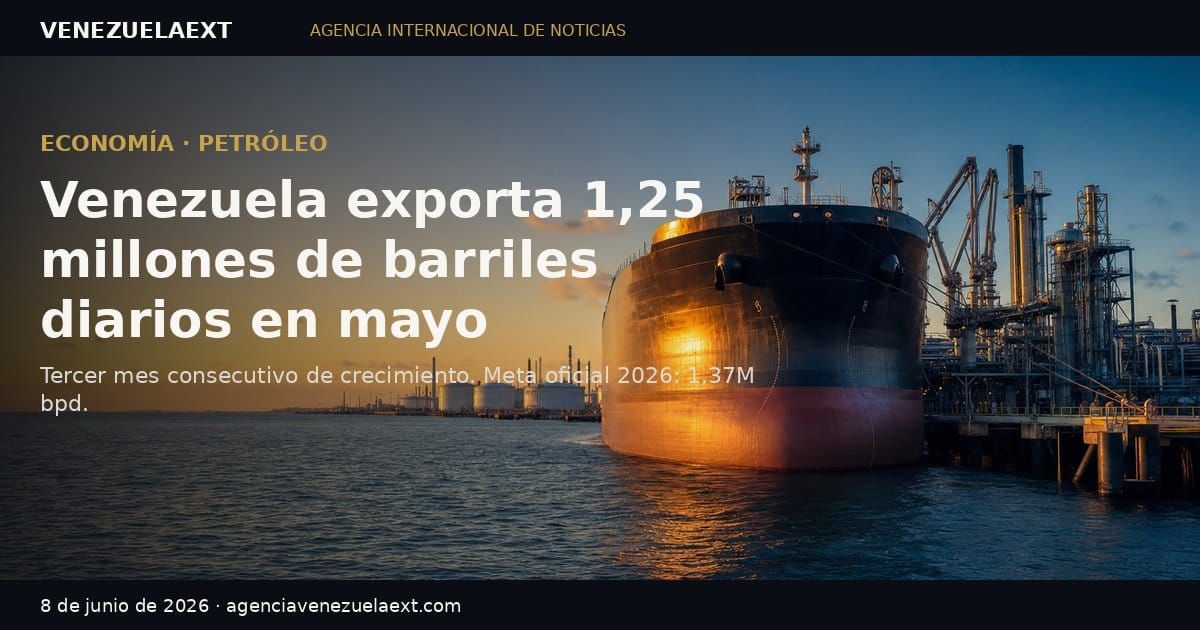
Dek. Venezuela's oil industry closed May with its highest export level since the 2019 U.S. sanctions. The United States, India and Europe account for 92% of shipments, while the Ministry of Hydrocarbons projects reaching 1.37 million barrels per day by year-end.
By Javier Romero — June 8, 2026
Lead
Petróleos de Venezuela (PDVSA) closed May 2026 with an average of 1.25 million barrels per day (bpd) exported, the third consecutive monthly increase and the highest level recorded since the United States imposed energy sanctions on the sector in 2019. The data, released by the Ministry of People's Power for Hydrocarbons and confirmed by international maritime tracking records, show year-on-year growth of 61% and consolidate Venezuela as the second-largest supplier of crude to the U.S. market, surpassed only by Canada. The official target for December is 1.37 million bpd, a level not seen in the country since before the first commercial restrictions.
The figure arrives at a defining moment of the administration led by acting President Delcy Rodríguez, whose government has, over five months, articulated energy agreements with U.S., European and Asian companies worth more than 2 billion dollars, according to official information from PDVSA and the Ministry of Hydrocarbons.
Context: from a 700,000-bpd floor to a sustained rebound
To understand the May figure, the historical series helps. Venezuelan oil output exceeded 3 million bpd in the early 2000s. After the sanctions cycle that began in 2019, volumes collapsed to around 700,000 bpd between 2020 and 2022. Recovery began to take shape in late 2022, when the U.S. Treasury granted Chevron a license allowing it to resume operations in the country.
The real turning point, however, came in the first quarter of 2026. In January, monthly average exports stood around 800,000 bpd (Transparencia Venezuela). From February onward, exports began a sustained upward trajectory: February, March and April all posted monthly increases, and May sealed the third consecutive month of growth.
The Organization of Petroleum Exporting Countries (OPEC) reported in its May bulletin that Venezuelan production stood at 1,031,000 bpd in April, up by 46,000 bpd versus March. For the first time in years, OPEC secondary sources confirmed production above one million barrels per day for Venezuela (Banca y Negocios).
BOX 1 — Venezuelan export series 2025-2026 (monthly average, thousand bpd)
Source: PDVSA, Ministry of Hydrocarbons, OPEC, Reuters. Compiled by VenezuelaExt.
Numbers of the present
The detail for May, according to official data and international maritime records analyzed by Reuters and reproduced by Venezuelan outlets (2001 Online, La Patilla), reveals a geographic composition concentrated in three destinations:
- United States: 558,000 bpd (44.6% of total)
- India: 427,000 bpd (34.1%)
- Europe: 169,000 bpd (13.5%)
- Caribbean terminals (storage): 58,000 bpd (4.6%)
- Other destinations: 38,000 bpd (3%)
The three main markets — the U.S., India and Europe — all increased their purchases versus April, confirming firm demand. Exports to Caribbean storage terminals, by contrast, dropped from 187,000 bpd in April, a technical signal that crude is being absorbed directly by refineries rather than accumulating in intermediate hubs.
The José terminal and offshore buoys, the country's two key export infrastructures, operated at maximum capacity throughout the first half of the year, according to PDVSA information relayed by domestic outlets (Telesur YouTube). In total, 67 cargoes left the country during the month.
In addition to the 1.25 million bpd of crude and refined products, Venezuela dispatched 288,000 metric tons of petrochemical products in May, alongside imports of 93,000 bpd of heavy naphtha, a technical input needed to dilute the extra-heavy Orinoco crude and make it exportable.
BOX 2 — Who moves Venezuelan crude (May 2026, bpd)
Source: maritime records analyzed by Reuters. Compiled by VenezuelaExt.
Actors: Chevron, Vitol, Trafigura and the new business configuration
The operational snapshot of May shows a structural shift in who moves Venezuelan oil. Trading companies authorized by the United States — chiefly Vitol and Trafigura — went from dispatching 691,000 bpd in April to 787,000 bpd in May, consolidating their position as the main outlet for Venezuelan crude. These two firms concentrate around 56% of total exports for the month (Instagram VenevisionPlay).
Chevron, PDVSA's principal operating partner in joint ventures, reduced its exports from Venezuela from 308,000 bpd in April to 269,000 bpd in May, a 13% drop attributable to scheduled maintenance and cargo redistribution toward authorized operators. The company maintains a joint production close to 260,000 bpd and has announced investments exceeding 100 million dollars to modernize infrastructure (CiberCuba).
In April, Chevron and PDVSA signed an asset-swap agreement involving the Loran field (offshore gas shared with Trinidad and Tobago) in exchange for a heavy-crude license in the Ayacucho 8 field of the Orinoco Belt, expanding its stake in the Petropiar joint venture and raising its share in PetroIndependencia to 49% (Servindi). That same company saw its operating window extended to 2050 by the National Assembly on June 3 (Efecto Cocuyo).
India's Reliance Industries has consolidated itself as one of the three top buyers of Venezuelan crude in recent months. In May it bought cargoes directly from PDVSA and also through providers such as Chevron, Vitol and Trafigura. This channel diversification reduces supply-chain exposure to localized disruptions.
In parallel, other international companies have signed memoranda and term sheets with PDVSA so far in 2026:
- BP (United Kingdom): memorandum for natural gas exploration and production
- ENI (Italy): term sheet for primary activities in the Junín 5 area of the Orinoco Belt
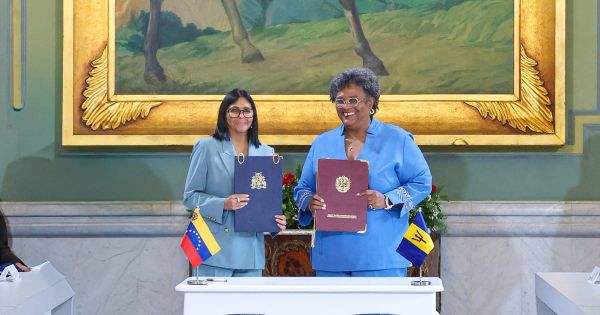
- Overseas Oil Company (U.S.): agreement signed at Miraflores Palace in May
- Crossover Energy Holding (U.S.): agreement signed at the same meeting
These alliances, signed during a high-level meeting between President Delcy Rodríguez and a delegation of U.S. business leaders and officials, project investments above 2 billion dollars in oil, gas and mining under a mixed-enterprise model with shared benefits (Telesur).
The official voice: Ministry of Hydrocarbons
The Minister of People's Power for Hydrocarbons, Paula Henao, confirmed in May that Venezuelan oil production reached 1,208,000 barrels per day. Henao stated that the signed agreements will focus on developing fields in the Orinoco Petroleum Belt and northern Monagas, under a model aimed at "monetizing the country's hydrocarbon reserves" and strengthening the sector through international capital integration (Telesur).
PDVSA, for its part, released in early June a balance of the first four-month period highlighting three relevant energy milestones between January and May 2026: the export of the first cargo of liquefied petroleum gas (LPG), the signing of "various agreements with international companies for the development of investments in oil and gas," and progress in workforce professional qualification (PDVSA Facebook official).
The state-owned company stressed that "the agreement with Chevron guarantees productive continuity in the Orinoco Petroleum Belt, under a long-term vision and an association model that integrates international investment with local capabilities to maximize the use of national resources," in line with the strategy of stable reintegration into the global energy market.
BOX 3 — Energy milestones January-May 2026January: agreement with the United States for the supply of approximately 50 million barrels valued at 2 billion dollarsMarch: U.S. Treasury General License No. 46 — flexibilization of operations with Venezuelan crudeApril: Chevron-PDVSA asset swap in Loran/Ayacucho 8; expanded stake in PetroIndependenciaMay: PDVSA-Overseas Oil-Crossover Energy agreements signed at Miraflores; first LPG cargo exported; memoranda with BP and ENIJune 3: National Assembly approves PetroIndependencia extension through 2050
Source: PDVSA, Ministry of Hydrocarbons, National Assembly. Compiled by VenezuelaExt.
United States: back to the top client
The most significant commercial datapoint is the consolidation of the United States as principal buyer of Venezuelan crude. According to the U.S. Energy Information Administration (EIA), in the first week of May Venezuelan exports to the U.S. reached 588,000 barrels per day, the highest weekly figure since before the 2019 sanctions. The volume was 47% higher than the previous week and 323% higher than the same period last year (NTN24).
With that figure, Venezuela ranks as the second-largest crude supplier to the United States, behind only Canada and above Saudi Arabia. Venezuelan exports to the U.S. totaled 1.8 billion dollars in the period, of which 96.5% corresponded to crude oil (Bloomberg Línea).
The consolidated business model functions in three stages:
- PDVSA sells crude at a discount estimated at 15 dollars per barrel versus the Brent benchmark
- Authorized traders (Vitol, Trafigura and others) take the cargo, transport it and resell it
- Gulf of Mexico refineries (Valero, Phillips 66, Reliance in its U.S. operation, among others) process it with final discounts of 8.5 to 9.5 dollars per barrel
This scheme ensures a stable outlet for Venezuelan crude and, at the same time, guarantees Gulf Coast refineries a reliable supply of heavy crude — a segment in which these plants are technically specialized.
Official outlook: 1.37 million bpd by year-end
The Ministry of People's Power for Hydrocarbons projects closing 2026 with production of 1.37 million bpd, which would imply a 22% increase versus the 1.12 million bpd at the end of 2025 and a level not seen since before sanctions (Finanzas Digital).
The target rests on four vectors announced by the Hydrocarbons portfolio:
- Projected investment: 1.4 billion dollars for the oil sector in 2026, versus 900 million executed in 2025 — a 55% increase
- Well reactivation in the Orinoco Petroleum Belt, which concentrates 303 billion barrels of proven reserves (the largest in the world)
- Expansion of joint ventures with international partners in Monagas, Anzoátegui and Zulia
- Reincorporation of operators under the updated Hydrocarbons Law framework
The president of the African Energy Chamber noted in an analysis published in May that, under Rodríguez's leadership, "production has recovered to approximately 1 million barrels per day in early 2026" and highlighted that Venezuela's compliance with OPEC commitments over the past five months "has contributed to sustaining global oil market stability" (Energy Chamber).
Risks and tensions of the process
The operational scenario is positive, but the rebound's sustainability depends on several factors worth monitoring in coming quarters:
Dependence on specific licenses. A significant share of activity operates under general and particular licenses issued by the U.S. Treasury (General License No. 46 and bilateral authorizations). Their renewal or modification directly affects exportable volumes.
Infrastructure. The José terminal and offshore buoys are operating at maximum nominal capacity. Sustaining growth beyond 1.3 million bpd will require logistical infrastructure investment — storage, channel dredging and new buoys.
Diluent imports. Orinoco Belt production requires heavy naphtha to be exportable. Venezuela imported 93,000 bpd of this input in May. Stable diluent supply is a critical variable for sustaining growing volumes.
Operational events. On May 15, 2026, an explosion occurred at the Lamargas Compression Plant, in Block 5 of Lake Maracaibo, Zulia state (PDVSA official statement). PDVSA activated industrial safety protocols and the situation was controlled without affecting the month's export pace.
International price. Venezuelan crude trades at significant discounts versus Brent. A sustained drop in international prices would reduce revenue even if physical volumes are maintained.
What's next: three indicators for the next 90 days
BOX 4 — What's nextJune-July 2026: PDVSA must publish the first-half report. Key indicator: if the semester average exceeds 1.15 million bpd, the annual 1.37-million target is reachable.Third quarter: effective entry into operation of the May Overseas Oil Company and Crossover Energy Holding agreements. Expected volume: an additional 30,000-50,000 bpd.August: next OPEC quota review. Venezuela will seek to consolidate its productive recovery within the assigned quota.
Closing
May's close confirms a trend that has ceased to be cyclical and become structural: Venezuela's oil industry is undergoing the most sustained recovery curve of the past seven years. With 1.25 million barrels per day exported, 67 cargoes dispatched, three main markets in growth and a signed investment agenda exceeding 2 billion dollars, the sector projects itself as the engine of the country's economic reactivation. The official target of 1.37 million bpd by year-end sets a demanding but credible horizon, sustained by verifiable data from the Ministry of Hydrocarbons itself, from PDVSA, from OPEC, and from international maritime records.
Sources
- PDVSA — official statement on energy milestones January-May 2026 (Facebook)
- Telesur — PDVSA signs energy cooperation agreements with U.S.
- La Patilla — Venezuelan oil exports rose to 1.25 million bpd in May
- 2001 Online — Reuters: Venezuelan oil exports increased in May 2026
- Finanzas Digital — Venezuela increases crude shipments to 1.25 million bpd
- Banca y Negocios — Venezuelan oil above US$90 and OPEC recognized production above one million bpd
- El Colombiano — Venezuela breaks its oil export record
- CiberCuba — Delcy Rodríguez announces arrival of more oil companies to Venezuela
- Bloomberg Línea — What is known about the oil companies arriving in Venezuela
- NTN24 — Below Canada, above Saudi Arabia: Venezuela's presence in the U.S. oil market
- Servindi — Chevron and PDVSA to extract oil in the Orinoco Belt
- Efecto Cocuyo — Venezuela extends operations of Chevron joint venture through 2050
- Energy Chamber — Venezuela under Rodríguez: a return to stability and opportunities
- Transparencia Venezuela — PDVSA and Venezuela's new oil order 2026 (PDF)
Javier Romero
VenezuelaExt News Agency — agenciavenezuelaext.com