Delcy Rodriguez announces the negotiation of 30 investment agreements and projects 2027 as a year of major economic momentum
In an interview conducted before the June 24 earthquake, the acting president details deals with GE Vernova, IMSA, Chevron and Repsol, previews the recovery of more than 6,400 megawatts and confirms that oil exports exceed 900,000 barrels per day.

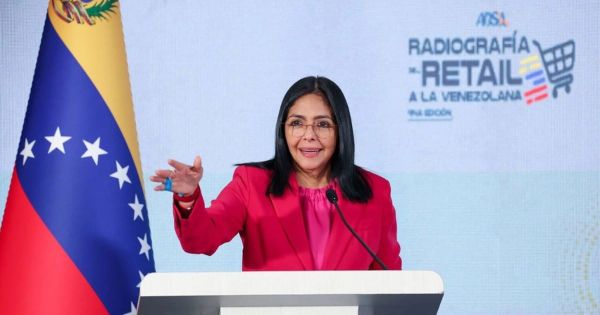
Venezuela's acting president, Delcy Rodriguez, confirmed that the government is negotiating 30 investment agreements with international companies and projected that 2027 will be "a year of major economic growth momentum" thanks to the foreign revenue those deals will bring in.
The remarks came in an extended interview conducted before the June 24 earthquake and published this week by the international outlet La Derecha Diario, in which the acting president reviewed the economic, energy and trade decisions taken during the first half of 2026.
The conversation stands as a mid-year assessment and previews many of the main lines the government has been advancing on investment attraction, hydrocarbons policy, recovery of the power grid and re-entry into the international financial system.
Thirty deals and the 2027 horizon
"We are negotiating 30 agreements — no longer memorandums of understanding but the actual agreements that will allow those investments to start flowing into the country," Rodriguez said in the interview. The figure confirms the gradual buildup the executive branch had displayed since the start of the year, with landmark memorandums signed with Chevron, Repsol, IMSA and General Electric Vernova.
According to the acting president, the current phase moves from preliminary understandings to enforceable contracts. "I have no doubt that next year, 2027, will be a year of major economic growth momentum thanks to the foreign revenue generated by the investments taking shape in hydrocarbons," she added.
The horizon Rodriguez outlined for 2027 rests on three pillars: full oil sector reactivation, recovery of the power grid and the arrival of new capital in mining, tourism and agribusiness.
Oil: 900,000 barrels exported
On the oil front, the acting president said Venezuela currently exports "more than 900,000 barrels per day" and that national output has returned to 1.2 million barrels per day, the level recorded in December 2025.
"We expect to close the year, without counting any of the investments we are now signing, at close to 100" percent of the projected target, Rodriguez said. The forecast rests on the fiscal framework of the Productive Participation Contracts in Hydrocarbons added to the Organic Hydrocarbons Law, which have already added more than 200,000 barrels per day over the past year.
According to the acting president, the legal design channels investment under a stable framework and eliminates reliance on temporary licenses. "A businessperson, an investor who comes to invest in the country and is told, 'you have a license for three months, six months, a year, two years,' — that runs against economic freedom," she argued as she called for an end to sanctions and the removal of individual licenses.
Electricity: 6,400 megawatts on the way
The energy chapter includes concrete advances in the national power grid. Rodriguez detailed the deal with IMSA, which will restart the Tocoma hydroelectric plant with a projected 2,400 megawatts, and the agreement with General Electric Vernova, which will add 1,000 megawatts in the first 24 months and up to 5,000 megawatts over four years.
"Just imagine what 2,400 megawatts plus 5,000 megawatts means: it is practically half of what Venezuela already generates," the acting president said, describing the scale of the recovery the two deals bring.
The power system, Rodriguez said, "is the king — or queen, if you prefer — of services. It is the most important of all. Water depends on it, hospitals depend on it, schools, food, agribusiness — everything depends on it." The IMSA agreement also covers part of the generation at Macagua, in the Lower Caroni.
Mining, gold and other sectors
On mining, Rodriguez said gold output is rising both at state-owned plants and in the private sector, and that the new legislation "is creating the right conditions for the investments required in mining. We already have many expressions of interest from international companies who want to come and invest, and they can now do so with full confidence."
The acting president also cited the role of the International Center for Productive Investment as a one-stop shop for foreign investors. The agency was reinforced with the recent appointment of a new sector vice president and consolidated as the counterpart for expressions of interest from abroad.
Rodriguez added tourism to the map as one of the priority engines. "Venezuela has it all: desert, snow, plains, mountains, jungle, coast. It is a multi-destination country, and a multi-destination country needs investment in the tourism sector," she said, extending an invitation to Spanish hotel operators to join the process.
Financial reintegration and debt restructuring
Rodriguez framed the investment cycle within a broader goal of full financial reintegration. The acting president said work is under way on "Venezuela's return to the international financial system, so that both public and private banks can recover their correspondent relationships" — a condition she considers essential for the exchange market to operate smoothly.
At the same time, she said restructuring the foreign debt is a strategic priority: "I want that foreign debt restructuring process to stop being a huge weight on the Venezuelan people and to become an engine that lets Venezuela drive all the country's productive factors."
The acting president laid out a medium-term perspective. "I am thinking about a Venezuela three, five, 10, 20 years from now, an economy that is powerful and serves the great needs of the Venezuelan people," she said.
Wages, food and inflation
The social chapter of the interview included data on wages and domestic consumption. Rodriguez said the minimum income for public-sector workers rose from $30 to $240, and in the private sector from $78 to $270, between 2020 and 2026.
The acting president also reported that food consumption grew close to 10 percent in May and that 96 percent of the food consumed in the country is nationally produced. "There is full supply, as I have not seen Venezuela have in the last 20 years," she said.
On prices, Rodriguez acknowledged that projected annualized inflation exceeds 500 percent — "very high," she said — but is far below the 344,510 percent recorded in February 2019. "We know what we are doing, and above all we know what we are doing to bring inflation down," she said, noting that price containment is one way to protect workers' purchasing power.
Audits and transparency on revenue
Rodriguez said Petroleos de Venezuela has resumed audit processes with international firms, "as any transnational oil company in the world does," and announced that revenue from the new investments will be open to public scrutiny.
"I have also made it available so that any citizen — man or woman — can see, beyond an audit, exactly what the revenue is and how it is being invested," the acting president said.
In her reading, that transparency framework is part of an economic model in which oil and tax revenue "cover 71 percent of the investment in workers' income" — an investment, she stressed, that "is not an expense."
An assessment recorded before the earthquake
The interview was recorded weeks before the June 24 earthquake, an event that reshaped the government's agenda and heightened the need to translate those investments into executable flows. Many of the decisions described by Rodriguez — especially in the energy sector and those linked to reconstruction — took on added significance after the quake.
The agreements with IMSA on Tocoma, with General Electric Vernova on the power grid and the negotiations with Chevron and Repsol have now become part of the core of the Venezuela Renace plan, which took on the coordination of post-earthquake reconstruction and productive recovery.
In that context, the projection of 30 executable agreements and of 2027 as a year of major economic momentum becomes the benchmark against which to measure the process during the second half of the year.