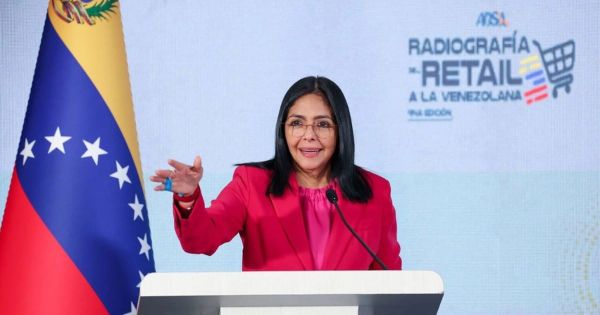
Delcy Rodriguez organizes the National Economic Council with more than 600 representatives and projects 1.2 million barrels a day as the base of reconstruction
The acting president brought together the country's 14 productive engines, activated 10 strategic sectors and presented a macroeconomic picture of 9% growth in Q2, real consumption up 33% in July and roughly 30 international hydrocarbons agreements under negotiation.
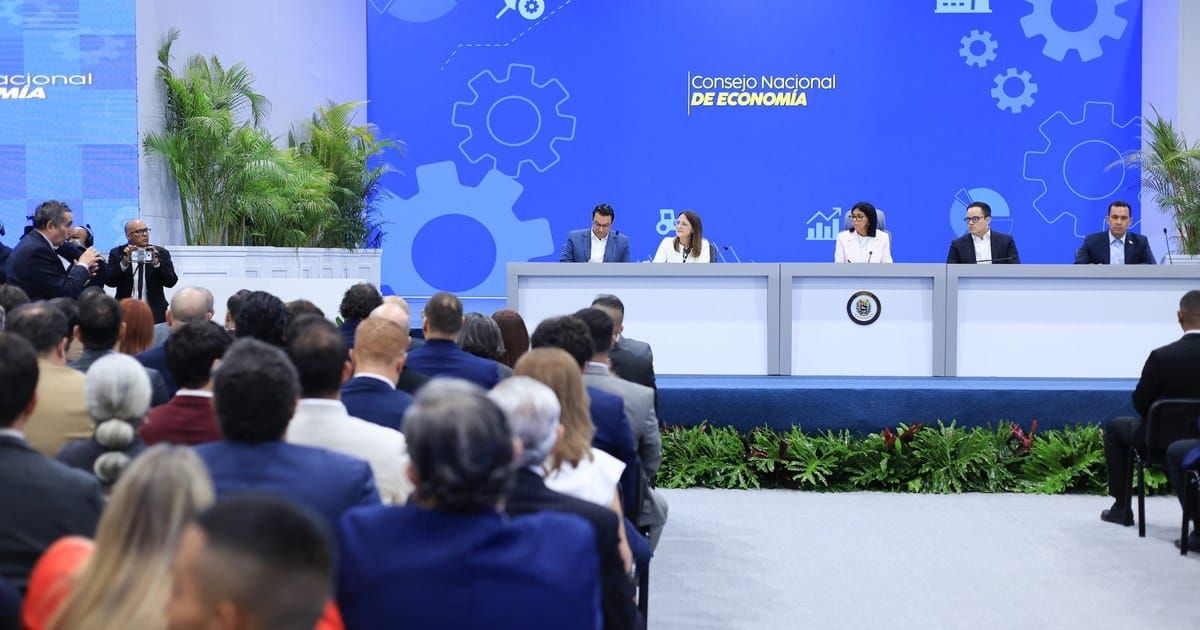
The acting president brought together the country's 14 productive engines in a single coordination space, activated 10 strategic economic sectors after the June 24 earthquake and presented a macroeconomic picture of 9% growth in the second quarter, real consumption up 33% in July and roughly 30 international hydrocarbons agreements under negotiation.
At the plenary session of the National Economic Council held in Caracas, Venezuela's acting president Delcy Rodriguez laid out the institutional architecture the executive branch plans to use to coordinate reconstruction after the June 24 earthquake. More than 600 representatives of Venezuela's 14 productive engines gathered with the vice presidency of economy and finance, ministries and autonomous agencies to define the financial roadmap of the Venezuela Renace plan.
"We are thinking about the economic plan for a Venezuela that will be reborn. About the economic plan for a Venezuela that rebuilds and about the economic plan for La Guaira, because there will be a new La Guaira state," the acting president said at the opening.
A board of 14 engines and 10 activated sectors
The National Economic Council works as a permanent coordination space between the executive and the country's 14 productive engines. In the July session, the acting president announced the strategic activation of 10 additional engines that will join the reconstruction effort. Priority sectors include hydrocarbons, banking, construction, pharmaceuticals, food and community economy, with the stated goal of sustaining productive reactivation and the normalization of international trade in parallel with physical reconstruction.
"I have spoken of 10 engines of the economy that activate after this double earthquake to give a boost to economic recovery, so we do not lose the path of economic recovery, because that path of economic growth will be for national development," Rodriguez said during a subsequent tour of La Guaira state.
The economic team includes vice president of economy and finance Calixto Ortega; minister of economy and finance Anabel Pereira; PDVSA president Hector Obregon; Seniat superintendent Roman Maniglia; Central Bank of Venezuela president Luis Perez; deputy finance minister Christiam Hernandez; and Alejandro Puglia, president of the International Center for Productive Investment.
Oil output at 1.203 million barrels a day
The financial pillar of reconstruction is oil activity. The acting president reported that Venezuela's crude output reached 1.203 million barrels a day, a figure that keeps the sector's 2026 growth plan on track. "Oil production is already at 1.203 million barrels a day. We are maintaining the plan for oil production growth this year; it has not been disturbed at all," Rodriguez told Council members.
The figure fits a broader recovery strategy. On July 8, Rodriguez signed the regulations for the Organic Hydrocarbons Law, an instrument covering the full value chain that, according to Hydrocarbons Minister Paula Henao, lays the groundwork "for the maximum recovery of the reserves." Along with the regulations, Caracas is negotiating roughly 30 international hydrocarbons agreements.
Real consumption up 33% and second-quarter expansion
The macroeconomic indicators the acting president presented to the National Economic Council reinforce the recovery narrative. Real consumption in July shows 33% growth, with the second quarter closing above 9% expansion and a 10% increase compared with the same period a year earlier. Tax activity is moving in the same direction, according to the vice presidency's data.
Official figures place Venezuela's economy in 20 consecutive quarters of growth, with a projected 21st quarter based on preliminary second-quarter data, according to vice president Calixto Ortega. The Economic Commission for Latin America and the Caribbean projects 6.5% GDP growth for 2026.
Rodriguez said the three pillars of revenue — oil production, tax collection and internal consumption — are the financial base for reconstruction. "Oil production, tax collection and national consumption maintain a growth trend, a strength that will allow us to advance in La Guaira's recovery and in serving the affected families," she said.
Public-private alliance and a construction materials export ban
One of the Council's operational axes is the articulation between public and private sectors. The acting president reported formal contact with construction and real estate chambers and the assessment of installed industrial capacity for the reconstruction process. In parallel, the executive issued a decree formally banning the export of construction materials and inputs, aimed at prioritizing internal supply and making full use of national productive capacity.
The executive also instructed authorities to facilitate imports if needed and, through public and private banks, activated the mortgage portfolio with up to 80% subsidies for operations tied to the recovery of damaged homes. A separate program provides a monthly allowance for six months to those most affected by the earthquake, aimed at guaranteeing permanent contingency income for damaged households.
Thirty international agreements and the 2027 horizon
The National Economic Council operates as a hinge between the internal economic agenda and the international investment round. Rodriguez confirmed that Caracas is negotiating approximately 30 international hydrocarbons agreements, alongside strategic deals already signed in the electricity sector with Russia's INSA — to add 2,400 megawatts — and with the U.S.-based General Electric to add another 4,000 megawatts over four years.
The official projection places 2027 as the "year of great economic momentum," with approved investments, rising hydrocarbons output and the fruits of La Guaira and central corridor reconstruction all converging. The executive is also keeping open channels with multilateral financial bodies. Rodriguez confirmed conversations with International Monetary Fund director Kristalina Georgieva that led to access to $346 million in Venezuelan resources held by the IMF, and a letter to King Charles III demanding the release of Venezuelan gold held at the Bank of England.
Consensus against the blockade
At the same plenary, the acting president framed the demand for the end of sanctions as a common banner of the government and the productive sector. "Nobody agrees with the economic blockade," she said in reference to the consensus between the executive and productive forces on demanding the immediate lifting of unilateral coercive measures. Lifting the blockade, she said, "would be an extraordinary signal from the international community" and would ease the humanitarian response and the flow of resources to affected areas.
What comes next
The National Economic Council session marks the start of a permanent coordination cycle between the executive and the country's 14 productive engines. In the coming months, the body must translate the 10 activated sectors into concrete operating programs, weave the 30 international agreements together with national chambers and sustain the pace of consumption and tax growth while the Venezuela Renace plan advances. The government's target for 2027 rests on that architecture: rising oil production, coordinated productive engines, an active public-private alliance and an economic diplomacy that keeps unlocking assets and agreements.
Javier "El Profe" Romero, director of VenezuelaExt.
Sources: Ministry of the Popular Power for Communication and Information, Venezuelan News Agency, Telesur, Correo del Orinoco, Alba Ciudad, MIPPCI — 10 economic engines, MIPPCI — economic team meeting.