6.76 million affected, 24 nations mobilized: anatomy of the largest humanitarian deployment in 21st-century Latin America
On day four after the quake, OCHA coordinates 25 international teams (17 USAR + 8 medical) with close to 1,000 personnel from 24 countries. Toll: 920 dead, 3,360 injured, 50,000 missing according to the U.N., 6.76 million affected according to IOM.
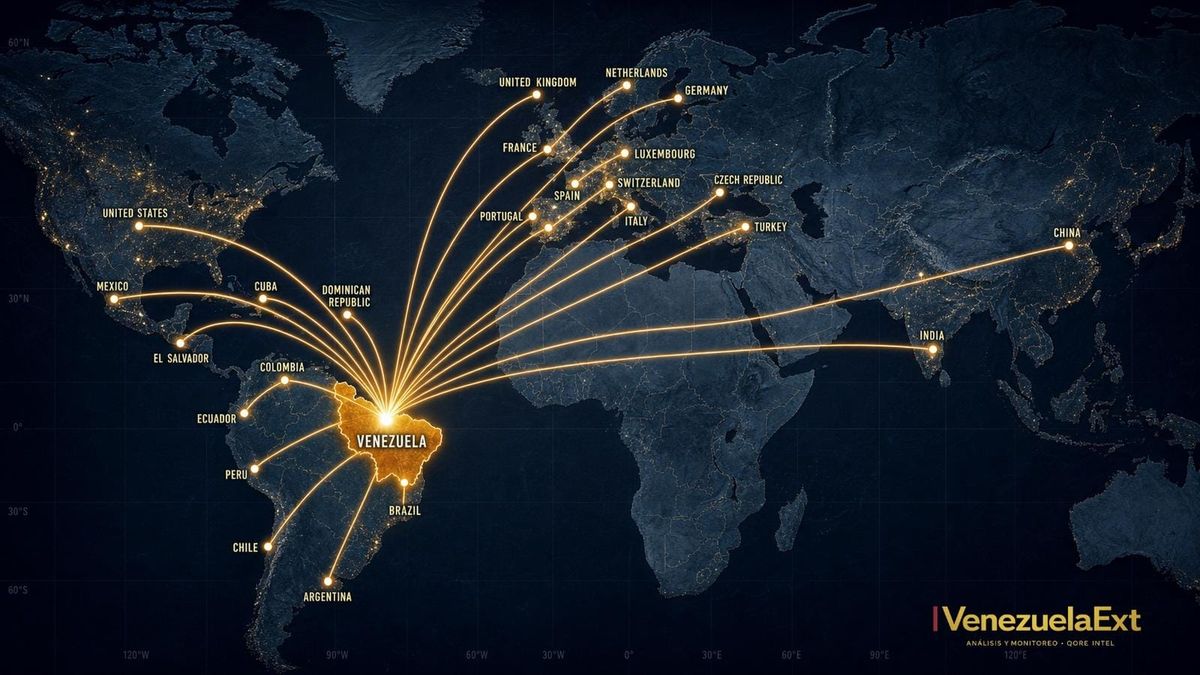
CARACAS — On the fourth day after the magnitude 7.2 and 7.5 earthquake doublet that struck north-central Venezuela on Wednesday, June 24, the international response has shifted from a trickle of announcements into what is now the largest coordinated humanitarian operation in Latin America so far this century. The official toll at the end of Friday stood at 920 dead, 3,360 injured, 50,000 people reported missing according to the United Nations, 6.76 million people affected according to the International Organization for Migration, 302 aftershocks recorded by Venezuela's seismological agency (Funvisis), and 172 people still trapped under rubble. On the ground, 25 international teams — 17 USAR and eight emergency medical — with close to 1,000 personnel from 24 countries and one European regional mechanism are now operating, under the coordination of the U.N. Office for the Coordination of Humanitarian Affairs (OCHA) and the single ground command of Maj. Gen. Domingo Hernández Lárez.
Map of the 24 mobilized countries converging on Venezuela. Photo: VenezuelaExt — editorial recreation based on official sources.
This story is an anatomy of that deployment: who arrived, with what capabilities, on which front, and what political realignment becomes visible once the full map is drawn.
Civilian command: OCHA and the U.N.
The framework holding the operation together rests on an institutional decision taken in the first hours: OCHA assumed operational coordination of all foreign teams, working in concert with the Emergency Joint Command chaired by acting President Delcy Rodríguez. OCHA spokesman Jens Laerke, speaking from Geneva, confirmed the office is "fully mobilized" and that the immediate priority is to avoid duplication of effort across the hardest-hit states of Yaracuy, Cojedes and Aragua.
Backing OCHA's coordination role are the World Food Programme, preparing to scale up assistance to the 3,007 displaced people already registered; the International Organization for Migration, which placed the figure of directly and indirectly affected at 6.76 million; and the International Federation of Red Cross and Red Crescent Societies, which launched a global appeal of 50 million Swiss francs and dispatched a first convoy of 17 tons of aid from Panama. The World Bank is conducting a damage assessment and the Development Bank of Latin America (CAF) has opened a Reconstruction Fund with $1 million in seed capital.
Latin America: the first ring
The Latin American bloc was the first to arrive and provides the largest number of personnel on the ground.
- Mexico. President Claudia Sheinbaum sent more than 250 military personnel, the civilian Los Topos rescue brigade, five canine teams and four transport aircraft. It is the largest single contingent in the entire operation.
- El Salvador. President Nayib Bukele deployed 300 rescuers, 50 tons of equipment and six aircraft. The operation was announced personally from San Salvador and is one of the largest in the history of Salvadoran humanitarian cooperation.
- Colombia. President Gustavo Petro sent the USAR COL-1 team with 63 rescuers and 12 tons of equipment, including specialized canine units.
- Brazil. The government of Luiz Inácio Lula da Silva deployed 36 firefighters specialized in collapsed structures, two KC-390 Millennium aircraft and its Defense Minister on the ground in Maracay.
- Chile, Ecuador, Peru, Dominican Republic, Cuba, Nicaragua and Panama complete the first ring. Ecuador sent 60 rescuers and two dogs; Peru, 44 personnel with USAR equipment; the Dominican Republic, a mobile hospital with 40 specialists; and Chile covered two flights of medical and logistical supplies.
- Argentina. The government of Javier Milei sent an Embraer, a C-130 Hercules, flights from Aerolíneas Argentinas, water purification plants, reconnaissance drones and White Helmets brigades.
Europe: 520 personnel under the Union's mechanism
The European Union Civil Protection Mechanism activated its largest off-continent deployment of the decade, with roughly 520 personnel distributed across nine member states plus the United Kingdom and Switzerland, both of which operate outside the Mechanism but in coordination with it.
- Spain. The main European contribution: the Military Emergency Unit (UME) with 59 personnel; the Madrid City Council Emergency Response Team (ERICAM) with 40; firefighters from Catalonia; and Bomberos Sin Fronteras. The size of the Spanish operation also reflects the weight of the Spanish community in Venezuela: Madrid has confirmed five Spanish nationals dead and 119 missing, plus 14 people trapped under rubble whose location is now an operational priority.
- Italy. The Italian deployment landed Saturday morning, following a phone call Friday night between Prime Minister Giorgia Meloni and acting President Delcy Rodríguez.
- Portugal. Sent 64 rescuers and 23 tons of equipment, with additional reinforcements from the Azores and Madeira. Portugal tragically leads the count of foreign casualties: 28 dead and 85 missing.
- France. President Emmanuel Macron deployed 85 Civil Security personnel.
- Germany. Mobilized six aircraft carrying medical supplies and search teams.
- The Netherlands. Sent 64 rescuers and eight canine teams, with an initial budget of 2 million euros.
- Switzerland. The Swiss Rescue corps deployed 80 specialists, eight dogs and 18 tons of equipment. It operates outside the EU Mechanism but in full coordination with OCHA.
- Czech Republic and Luxembourg rounded out the continental European contribution.
- United Kingdom. Prime Minister Keir Starmer's government sent 68 rescuers, six dogs, 2 million pounds, a Voyager aircraft and structural reconnaissance drones.
Asia and the bridge to the Pacific
The Asian deployment introduces the fourth day's most politically loaded detail: the simultaneous presence of India, China and Turkey on Venezuelan soil.
- India. Prime Minister Narendra Modi activated Operation Dosti ("Friendship"), with 41 rescuers, two C-17 Globemaster aircraft, two BHISHM field hospitals and 35 tons of medical equipment. It is the first time India has deployed its BHISHM system in the Western Hemisphere.
- China. The Chinese Red Cross sent a first shipment of aid and is preparing technical teams. Beijing complemented the effort with financial support channeled through multilateral mechanisms.
- Turkey. Mobilized two A-400M aircraft, 38 USAR personnel and 22 humanitarian workers specialized in reconstruction, drawing on Turkish experience from the 2023 earthquakes.
- Qatar, Jordan and Israel completed the regional contribution with small but highly specialized USAR teams.
The United States: the deployment with the greatest geopolitical weight
The U.S. deployment, alongside the European Union's, is what most rearranges the diplomatic board. The administration of Donald Trump announced Thursday the suspension of all financial sanctions on Venezuela through Oct. 23, in an order signed by Treasury Secretary Scott Bessent. The measure, announced together with a $150 million aid package, for the first time in years allows unrestricted financial transactions for the purchase of medicine, medical equipment, critical-infrastructure spare parts and food.
Operationally, the USS Billings and USS Fort Lauderdale — two U.S. Navy vessels — have positioned themselves in international waters off the Venezuelan coast to support logistics. Maj. Gen. Kevin J. Jarrard, of the Marine Corps, was designated by U.S. Southern Command as the operational liaison with the Emergency Joint Command on the ground.
The gesture, without precedent since 2017, goes beyond humanitarian assistance: it marks an inflection point that the international press is already starting to register as a historic shift in the bilateral relationship.
Solidarity beyond the state: the Church, the private sector, Starlink
Layered on top of state-led deployments is a constellation of non-governmental actors that accelerated the response.
- The Vatican. Pope Leo XIV sent an initial 100,000 euros and opened a special collection account through Caritas Internationalis.
- International Red Cross. Beyond its global appeal, it dispatched the 17-ton convoy from Panama.
- Shell. Contributed $5 million as a private donation and made its regional logistics available.
- Elon Musk. Enabled free Starlink service for all Venezuelans in affected areas, guaranteeing connectivity for rescue teams and for families coordinating searches via the government's VenApp platform.
- Vladimir Putin. The Russian president sent a letter of solidarity to Caracas without committing troops on the ground, in line with a foreign policy historically more diplomatic than operational in such emergencies.
The toll by nationality
The tragedy carries a global footprint in its casualties as well. By the close of Friday, foreign ministries had confirmed the following picture of foreign victims and active searches:
- Portugal: 28 dead and 85 missing.
- Spain: Five dead, 119 missing and 14 people trapped under rubble.
- China: Seven dead.
- Brazil: Two dead.
- Cuba: Two children missing.
- Chile, Dominican Republic and Italy: One death each (the Italian case is a dual-national Italian-Venezuelan).
The density of Portuguese and Spanish casualties largely explains the scale of the Iberian operation on the ground and the direct diplomatic coordination Lisbon and Madrid have maintained with Caracas from the first hour.
What the map reveals
When the map of the 24 mobilized countries is overlaid with the map of Venezuela's previous alliances, what comes into view is a realignment that no diplomatic process had achieved in four years. The entire Latin American bloc, the European Union, the United Kingdom, India, Turkey, China, the United States, the Vatican and a cluster of private global actors are operating simultaneously on the same territory, under the same coordination umbrella, toward the same objective. It is the first time in at least two decades that an event has pushed that combination of actors into articulated work on Venezuelan soil.
Acting President Delcy Rodríguez summed up the political meaning of the operation from the command post in Yaracuy on Saturday:
"Venezuela is not alone. What matters most are the lives we can still save. Let us hold together to save lives."
The phrase, repeated in every public appearance since Wednesday, has stopped being a slogan and become a description of the country's current state: a government led under a single civilian authority, a multilateral financial architecture activated for the first time, a humanitarian deployment without precedent in the region and a map of international allies that, four days ago, looked impossible.
What happens in the next 72 hours — as the windows of survival under rubble close and the operation begins to pivot from rescue to mass assistance for the displaced — will determine whether this architecture holds under pressure or starts to fray. For now, the numbers speak: 24 countries, 25 teams, close to 1,000 rescuers, 6.76 million people affected, one single coordination.
It is the anatomy of the largest humanitarian deployment Latin America has seen this century.
Javier "El Profe" Romero
Caracas