Reconstruction Diplomacy: Delcy Rodríguez Negotiates With London, the IMF and Washington to Unfreeze Venezuelan Assets
In two weeks, the acting president has opened simultaneous fronts with the British Crown, the IMF, CAF, the United States and Brazil. The goal: recover frozen resources to sustain the Venezuela Renace plan as reconstruction moves forward.
By Javier "El Profe" Romero
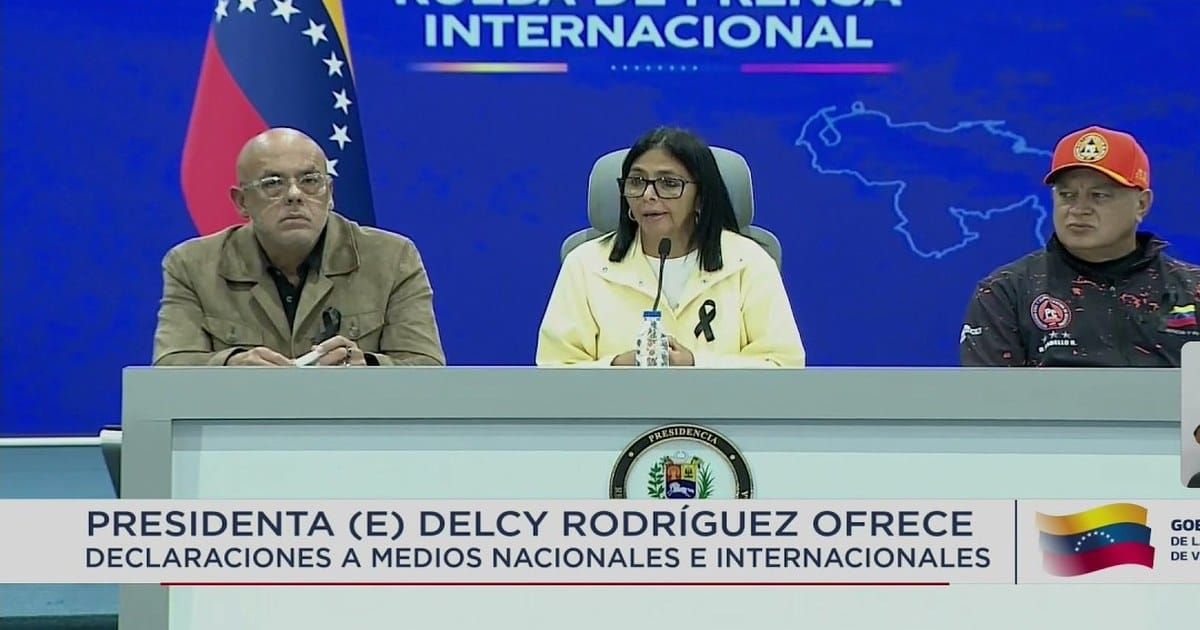
Over the past two weeks, Venezuela's acting president, Delcy Rodríguez, has launched a simultaneous international diplomatic offensive on five fronts: the British Crown, the International Monetary Fund, the World Bank, the White House and the government of Brazil. The stated goal is a single one: to unlock Venezuelan financial resources held abroad and channel them into the emergency response following the June 24 double earthquake.
The quake has left 4,333 dead as of July 12, 17,907 people displaced and 856 damaged buildings, according to the official tally released by the Emergency Command for the Creation of Transitional Camps (Telesur, Presidential Press Office). The projected housing need exceeds 25,000 units. The scale of the required investment is difficult to sustain with internal resources alone, and the diplomatic conversation reflects that reality.
The Letter to King Charles III
The most resonant move in the diplomatic sequence was announced by the acting president during a videoconference with those in charge of the 87 transitional camps installed across the country. Rodríguez confirmed that she had sent a formal letter to Britain's King Charles III requesting the release of Venezuelan gold reserves held at the Bank of England.
"I have decided to send a letter, among others, to the King of England to release the gold retained at the Bank of England. That gold belongs to our people, and it must be available to address the terrible, tragic consequences of this double earthquake," the acting president said (Telesur).
The reserves in question total 31 tons of gold bars valued at between $1.9 billion and $2 billion. They were frozen by British courts after the judiciary refused to recognize the administration of Nicolás Maduro (Página 12, Telesur). The fate of these assets has been the subject of legal dispute for six years. Rodríguez's letter reframes the claim under a new premise: humanitarian assistance for earthquake relief.
The Conversation With the International Monetary Fund
In parallel, the acting president held a direct call with Kristalina Georgieva, managing director of the International Monetary Fund. The purpose of the exchange was to unlock the immediate use of Venezuela's reserve tranche at the fund, roughly $350 million, and to explore access to more than $5 billion in Special Drawing Rights (SDRs) that belong to the country (Infobae, La Nación).
IMF spokesperson Julie Kozack confirmed the contact at a subsequent news briefing: "They discussed the use of Venezuela's reserve tranche at the IMF, which is an important source of liquidity that is easily accessible and can be mobilized rapidly" (Infobae).
SDRs are an international monetary reserve created by the IMF that can be converted into foreign currency to pay off debts or finance national programs. In Venezuela's case, they have remained inaccessible since 2019 due to the international recognition status that lapsed in the previous political cycle.
The CAF Account and the Venezuela Renace Plan
A third institutional front opened with the Development Bank of Latin America and the Caribbean (CAF). The Venezuelan government activated a special account at the regional bank to channel international donations for the reconstruction process (Telesur).
At the same time, an initial fund of $200 million was announced to launch reconstruction work under the Great Mission Venezuela Renace, officially presented July 7. The mission combines technical assessment of damaged structures, mortgage subsidies of up to 80% for the purchase of new homes, tax exemptions on real-estate transactions for affected families and a temporary ban on the export of construction materials (Venezuelanalysis, Presidential Press Office).
CAF's vice president, Cristian Asinelli, separately announced the creation of the Fund for the Recovery and Reconstruction of Venezuela, a multiyear vehicle focused on infrastructure, support for displaced families and the restoration of public services.
Washington, Brasília and the U.N. Undersecretary
Talks with Washington and Brasília are the fourth diplomatic front. The acting president said advanced conversations are underway with the United States, Brazil, the International Monetary Fund and the World Bank to facilitate the country's recovery after the disaster (Infobae).
At a meeting July 8, U.N. Undersecretary for Humanitarian Affairs Martin Fletcher agreed with the acting president on the need to ease the unilateral coercive measures on Venezuela to prevent them from disrupting the flow of humanitarian aid or stalling public-infrastructure recovery plans (Telesur).
International calls for the easing of sanctions have multiplied over the past two weeks. More than 100 economists signed a document requesting a relaxation of the economic sanctions against Venezuela, arguing that the current restrictions could hinder both reconstruction and broader humanitarian assistance (El Litoral).
Humanitarian Aid From 28 Countries
The collection center set up at La Carlota Air Base, in Miranda, has received 2,000 tons of humanitarian aid from 28 countries. Rodríguez inspected the operation July 8 alongside the sector vice president for Politics, Citizen Security and Peace, Diosdado Cabello, and Foreign Minister Yván Gil. During the visit, a technology platform was activated that allows each cooperating country to track the final destination of its contributions across camps and work sites (Alba Ciudad).
"The donations made through CAF, the coordination to receive rescue teams and the humanitarian aid have all been coordinated with the Venezuelan government. Which other government?" the acting president said during the international press conference of July 2. She added: "Here there is a Government, here there is a country and here there is a State" (Alberto Rodríguez News).
Reading the Pragmatic Turn
Rodríguez's diplomatic push is unfolding alongside a series of internal moves that analysts consulted by various international news agencies read as a pragmatic pivot by the current political project. The recent restructuring of the country's economic leadership team included the appointment of Román Maniglia as new head of the Seniat tax authority and of economist Calix Ortega Sánchez as new president of the Bank of Venezuela (El País).
That move was compounded by the partial unblocking of the social network X on private carriers such as Digitel and Movistar, after nearly two years of suspension imposed by the previous administration, and by the incremental opening of press accreditations to international journalists (EFE via Infobae). The accreditation process for foreign correspondents, which just a few months ago required a lengthy and complex work-visa procedure, was streamlined after the seismic emergency was declared.
Faced with the scale of the reconstruction investment required, the Bolivarian government reiterated its international demand for the release of legitimate financial resources and public assets that remain frozen abroad. Alongside the gold held in London, Venezuela says assets of Citgo — the U.S. subsidiary of state oil company PDVSA — and other sovereign holdings remain under external control, in amounts the administration estimates at several billion additional dollars.
Announced Next Steps
The work fronts opened by the Rodríguez administration for the coming weeks were laid out across several official announcements:
- The week of July 14–20: delivery of the first 200 homes built under the Venezuela Renace plan, with direct participation by the acting president (El Universal, Telesur).
- Rolling timeline: implementation of the Single Housing Registry for affected families, launched July 11 with a fingerprint-based system and individual traceability (El Diario, Telesur).
- Second half of July: official rollout of technical guidelines for the mortgage-credit portfolio, with subsidies of up to 80% jointly managed by public and private banks (Telesur, El Estímulo).
- September–October: official target to empty the schools currently serving as temporary shelters, in time for the regular start of the school year.
- Legislative reform in progress: the National Assembly is weighing a reform of the Rental Law to release approximately 200,000 unoccupied housing units nationwide (El Estímulo).
- Diplomatic front: continued monitoring of the formal proceedings with the British Crown, the IMF and multilateral bodies. No specific timelines or dates have been announced for official responses from counterparts.
At the same time, the Venezuela Renace mission continues to assess damaged structures: 186 buildings are currently undergoing intervention, and more than 8,500 damaged housing units require either repair or full reconstruction (Dailymotion — EC 10/07). Self-construction schemes, with the active involvement of community councils, are being defined as the operational vehicle for rural and peripheral areas.
The diplomatic sequence opened by the acting president configures, for the first time in several years, a simultaneous channel of conversation with the British Crown, multilateral financial bodies, Washington, Brasília and the United Nations system. The coming days will define whether these fronts produce concrete outcomes or remain, as has happened in previous cycles, in the realm of formal proceedings without operational translation.