Two Weeks In: 96% Power, 84% Water and a $37 Billion Reconstruction Ahead
Fifteen days after the twin earthquakes, Venezuela has restored 96% of electricity and 84% of water in La Guaira, while the UN estimates damages at $37 billion and Delcy Rodriguez asks the UK to unfreeze Venezuelan gold to fund reconstruction.
Two weeks after the twin earthquakes that struck Venezuela's central coast on June 24, the country is shifting the conversation. The search for survivors is nearly closed, the death toll continues to climb as bodies are recovered from the rubble, and, in parallel, the first indicators of a new phase are emerging: reconstruction.
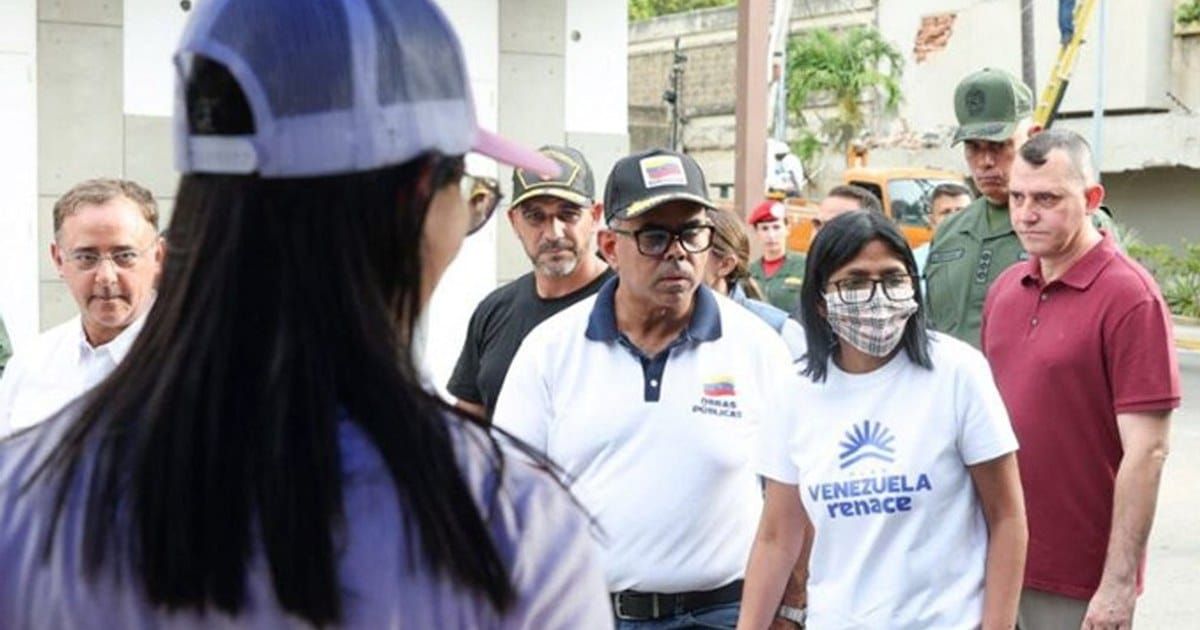
Acting President Delcy Rodriguez tours Macuto with the Public Works team and senior military commanders. Photo: Presidential Press Office of Venezuela.
The official report released Thursday by National Assembly President Jorge Rodriguez raised the death toll to 3,889 from the magnitude 7.2 and 7.5 quakes. The number of injured remains at 16,740, and people without homes or with severely damaged residences total 17,907. Authorities have rescued 6,462 people alive and assisted 86,794 families. The earth continues to move: 1,142 aftershocks have been recorded since that afternoon.
Material damage confirms the scale of the disaster. A total of 856 buildings have been damaged, of which 190 collapsed entirely, most concentrated in La Guaira state. Some 89 temporary shelters house 16,891 people, with more than 10,000 displaced on the central coast alone, distributed across 26 refuges currently being expanded. Caracas hosts more than 5,000 people and Miranda more than 1,000 in temporary facilities.
From emergency to services
Acting President Delcy Rodriguez visited Macuto on Thursday, accompanied by local authorities and senior military commanders. According to state broadcaster VTV, the government has restored 96% of electricity service in La Guaira, with 21 substations fully back online. Potable water distribution has reached 84%, while tanker trucks cover areas where infrastructure collapsed. State telecommunications company Cantv is advancing on network recovery, though no official figures have been released yet.
These numbers mark a turning point. Two weeks ago, much of La Guaira had no electricity or running water. Restoring these services, even partially, allows relief efforts to concentrate on families in temporary camps, debris removal and preparations to rebuild critical infrastructure.
The joint civil-military operations zone has been organized into 10 quadrants, each under the command of a brigade general, according to La Radio del Sur. A contingent of 6,400 troops from the Bolivarian Army is working directly with the population, and the overall operation has mobilized 30,076 personnel, 29,344 volunteers and 3,931 international rescue workers. Rodriguez said she will decorate the Bolivarian National Armed Forces for two weeks of uninterrupted work.
The number that frames reconstruction
The United Nations Office for Disaster Risk Reduction (UNDRR) on Thursday released its first estimate of direct physical damage to housing and infrastructure: $37 billion. It is a figure that resets the scale of the debate. It multiplies by more than five the initial estimate the Venezuelan government itself was using in the days after the quake, and places reconstruction in a range no single economy can face alone.
On that basis, and with the country still in mourning, diplomacy is on the move. Rodriguez sent a letter to King Charles III of the United Kingdom requesting the release of $1.9 billion in Venezuelan gold held at the Bank of England, earmarked specifically for reconstruction, according to La República. In parallel, the International Monetary Fund confirmed that Venezuela has access to approximately $350 million in a reserve tranche for rapid humanitarian emergencies, and holds another $4.5 billion in Special Drawing Rights that remain frozen. The two instruments together add up to nearly $5 billion in Venezuelan assets within the organization.
That financial architecture is joined by bilateral and multilateral cooperation already in motion. So far, $694 million in aid from 37 countries and 68 organizations has been committed, according to the consolidated tally by Transparencia Venezuela on the platform rutadeayuda.org. The civil society organization has called on multilateral bodies to channel resources with transparency. The UN Office for the Coordination of Humanitarian Affairs (OCHA) launched an additional appeal for $300 million to assist 1.3 million affected people over the next six months.
Health emergency continues
The Pan American Health Organization (PAHO) warned that the health emergency "is far from over." Its acting director in Venezuela, Armando De Negri, quoted by The Straits Times, pointed to risks tied to overcrowded shelters, limited access to potable water and rising cases of chronic illness and diarrhea in the hardest-hit areas. In La Guaira, about 300 victims were buried individually without being identified, with genetic material preserved to allow for later matches, according to Venezuela's forensic service.
Tom Fletcher, the United Nations' top humanitarian official, described the disaster as one that would be "incredibly difficult for any government in the world" to manage. The UN system is deployed on the ground and at the coordination tables with the interim government.
The road ahead
The coming days will mark the shift from one phase to another. The rescue phase is closing without fanfare, with international teams rotating out and debris removal taking over as the main task. Attention is now focused on three simultaneous fronts: consolidating assistance to displaced families, fully restoring basic services and opening the political and financial conversation on reconstruction.
The $37 billion estimated by the United Nations is, in practice, the cornerstone of a debate that is only beginning. No economy carries that bill alone. Venezuela, with part of its external assets still frozen and a complex macroeconomic outlook, will need a mix of freed domestic resources, bilateral cooperation, concessional multilateral loans and donations to rebuild La Guaira. The political equation behind that reconstruction — who pays, on what terms, under what controls — will be played out in the coming months.
Meanwhile, in Macuto, Playa Grande, Naiguatá and the rest of the central coast, families who lost everything are starting to do the long math: the math of returning to a life where the lights come back on, the water flows again, and the country has to decide what to rebuild first.