Day 10 Balance: 2,645 Dead, 707,063 Tons of Aid and a Diplomacy That Redefines Venezuela's Place in the World
Ten days after the twin earthquakes, Venezuela closes the rescue phase with 2,645 dead and opens a financial architecture with the IMF, IDB, World Bank and CAF. The cooperation of 147 governments redefines the country's place in the world.
Ten days after the twin earthquakes of magnitudes 7.2 and 7.5 struck northern Venezuela on June 24, the country is entering a new phase. The rescue effort is giving way to shelter, collective mourning and funded reconstruction. And on that pivot there is no longer room for doubt: the international response to this emergency has become the largest humanitarian operation Venezuela has coordinated in its modern history, and a diplomatic exercise that is quietly reordering the country's relationship with more than one hundred governments.
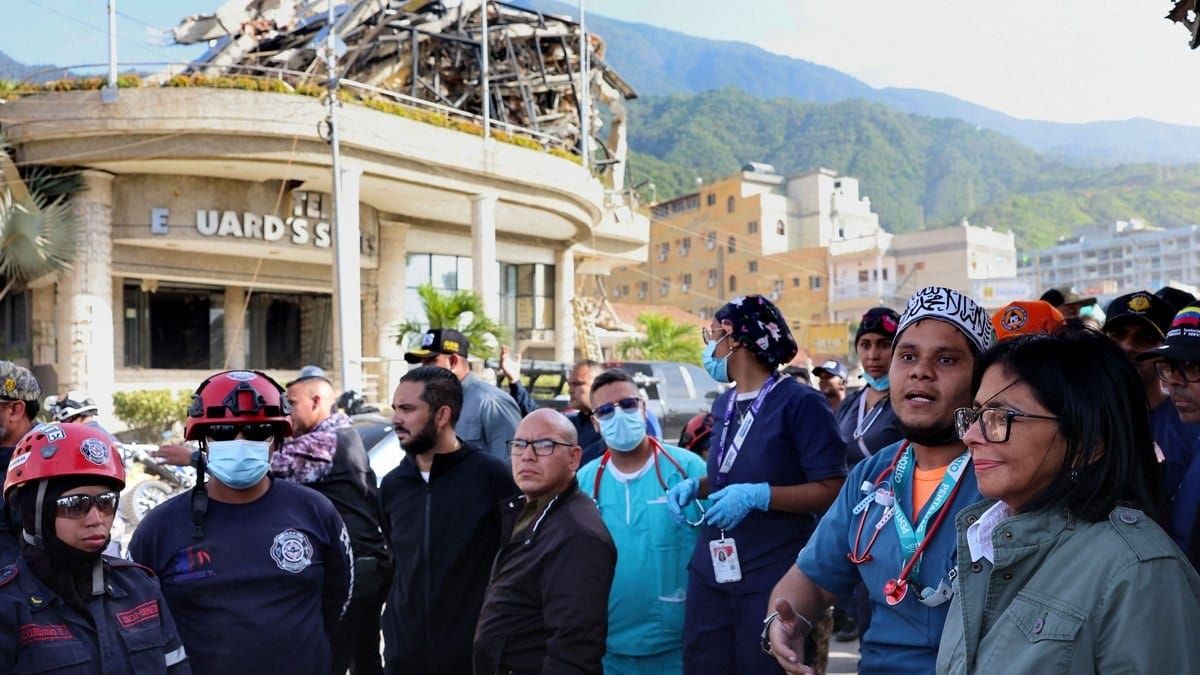
Acting President Delcy Rodriguez visits La Guaira alongside firefighters, medical personnel and national and international rescue workers. Photo: Presidential Press Office of Venezuela.
The final numbers of the first phase
The official toll released Friday, July 3, by the Ministry of Popular Power for Communication and Information and by the president of the National Assembly, Jorge Rodriguez —and confirmed again this Saturday, July 4— records 2,645 people dead, 12,666 injured and 6,462 rescued alive since the operation began. Damaged structures total 885 buildings, with 189 in total collapse —158 of them concentrated in La Guaira state— and 890 aftershocks documented by Funvisis, 48 of them on Friday alone.
Of all those affected, the government counts 15,050 people without housing and 86,117 families served by state operations. Medical and food distribution covered 9,486 tons of food, 78,478 food bags, 453,326 liters of water and medical care for 20,909 patients through the public and private health network and the field hospitals set up by foreign delegations (Presidential Press Office of Venezuela).
The scale of multilateral cooperation
The figure that redefines June 24 as a turning point is not in the rubble: it is in the international community that mobilized to help the country.
Acting President Delcy Rodriguez told foreign correspondents on Thursday, July 2, that 147 countries formally offered solidarity to Caracas within the first hours, and that 72 heads of state or government called directly during the first 48 hours of the emergency. On the ground, official teams from 27 countries across five continents and 31 international and multilateral organizations deployed, with 3,305 foreign rescue workers, 148 specialized dogs and 49 support vehicles, according to the Communication Ministry report (teleSUR, July 3).
By material volume, Venezuela received 707,063 tons of humanitarian aid from day one, according to National Assembly President Jorge Rodriguez. The operation also mobilized 29,567 Venezuelan personnel and 25,846 registered volunteers, with 59 transitional camps already opened to house more than 11,000 people organized by families, with support from psychology teams (Presidential Press Office).
Five continents, one map
The geography of aid draws Venezuela's new diplomatic place. From Latin America came teams from El Salvador, Mexico, the Dominican Republic, Ecuador, Chile, Colombia, Cuba and Brazil. From Europe joined Spain, Italy, the Netherlands, Portugal, Switzerland and the European Union Civil Protection mechanism, which activated a humanitarian air bridge from Copenhagen with 50 tons of supplies and unlocked an additional 5 million euros for medical assistance. Israel sent a team specialized in structural assessment. China announced emergency material worth 100 million yuan —about $14.7 million— for rescue and reconstruction (UN News, June 28; Europa Press, June 28).
In recent days, with the rescue phase closing its critical window, some international teams began an orderly withdrawal. Chilean firefighter Sebastian Mocarquer, of the UN's UNDAC team, confirmed that some 3,000 rescue workers from 29 countries still remain in the field after having saved 12 people alive during the last operational week.
Portugal declared national mourning in solidarity with Venezuela. And from Caracas, the acting president signed a decree on Wednesday, July 1, ordering seven days of official mourning running through Tuesday, July 8 (Europa Press, July 1).
The financial architecture of reconstruction
If the rescue phase showed the scale of solidarity, the phase now opening defines the economic engineering of the day after. And on that front, Venezuela is advancing with a financial architecture that combines its own funds, multilateral cooperation and targeted international donations.
The Venezuelan government created an initial $200 million fund for reconstruction and opened a special account at the CAF-Development Bank of Latin America and the Caribbean to receive earmarked donations. In parallel, it launched the portal venezuelanoestasola.com to channel international contributions, both monetary and in supplies.
CAF launched a multi-donor fund of up to $200 million specifically for Venezuela's reconstruction, with a multi-year working horizon. Its executive vice president, Christian Asinelli, preliminarily estimated material damage at $6.7 billion, equivalent to about 10% of Venezuela's gross domestic product, and calculated that full reconstruction will require an investment above $15 billion (teleSUR, June 29).
The Inter-American Development Bank (IDB) announced an initial donation of at least $1 million to support emergency work, its president, Ilan Goldfajn, confirmed on July 2 (Europa Press, July 2).
At the same time, Caracas opened talks with the International Monetary Fund, the World Bank and the U.S. State Department to secure credit lines and non-reimbursable resources for infrastructure reconstruction. The institutions "have already offered non-reimbursable cooperation to support the recovery process, in addition to credit lines," Acting President Delcy Rodriguez said in her appearance before foreign correspondents (teleSUR, July 3).
The diplomatic turning point
Ten days ago, Venezuela's ties with the main multilateral financial institutions were marked by years of distance. Today, the humanitarian emergency has opened simultaneous tables with the IMF, IDB, World Bank and CAF. The quality and scale of that cooperation —added to the bilateral response of 27 countries on the ground and 147 on the diplomatic plane— sets a paradigm shift no Venezuelan government has managed to build in the last two decades.
The operation itself worked as a testing ground for a multivector diplomacy: brigades from Cuba and the United States coordinating rescues in La Guaira; teams from Mexico, Chile, Ecuador and Spain working side by side in Playa Grande and Caraballeda; Dutch ships departing from Curaçao with food and water; China contributing funds and Russia expressing institutional solidarity. For ten days, La Guaira became the largest humanitarian meeting point in the region.
The phase now opening
With the search for survivors narrowing to selective operations in still-unstable structures —13 people were pulled out alive by international teams during the past week, according to UNDAC— the government is now concentrating efforts on three fronts.
The first is structured shelter: the 59 transitional camps are being consolidated with psychological support teams and family-based organization. The UN's World Food Programme (WFP) plans to assist half a million people housed in shelters set up after the emergency, according to its country director, Stephanie Hochstetter.
The second is the structural audit of affected zones. Delcy Rodriguez announced on Sunday, June 28, the immediate creation of a special commission to inspect damaged homes and determine habitability, chaired by Jorge Rodriguez himself, and extended the suspension of classes for an additional week. Electric service has been restored to 90% in La Guaira; water distribution to the same level. Telecommunications rehabilitation has reached 70% (teleSUR, June 29).
The third is housing reconstruction. The government has announced exemptions from notary and real estate registration fees, negotiations with banks for housing loans and the reactivation of public housing projects in the hardest-hit areas.
National mourning and continuity of government
This Saturday, July 4, Venezuela is on the third day of official mourning. Flags at half-staff, commemorative national broadcasts and spontaneous tributes in La Guaira accompany the final stretch of the rescue phase.
Institutionally, Acting President Delcy Rodriguez acknowledged Thursday before the international press that she is facing "a health condition" and "a deep inner pain," but assured that the continuity of the government's response is not affected. The appearance —her first with open questions from foreign correspondents since her designation— was organized around five axes: rescue, international cooperation, medical care, camps and reconstruction.
Ten days on, the toll keeps growing. But above the tragedy, what has consolidated is a political lesson: in its worst modern emergency, Venezuela received a simultaneous response from 147 governments, four major multilateral institutions and UN agencies. That fact, more than the numbers, defines the country's new place in the world.
About this series: Venezuela desde afuera / Venezuela from abroad is an international community of friends of Venezuela following day by day the facts, data and decisions shaping a country where millions were born and live. This is dispatch number 24 of our continuous coverage of the twin earthquakes of June 24, 2026.
Byline: Javier "El Profe" Romero, from Caracas — July 4, 2026.