Venezuela Underground: How the Response to One of the Strongest Earthquakes of the Century Was Organized
Forty-eight hours after the magnitude 7.2 and 7.5 doublet, the Venezuelan state consolidated a response architecture under unified civilian command, with a $200 million IMF fund and U.N. coordination. Official count: 589 dead, 2,980 injured, 214 aftershocks.
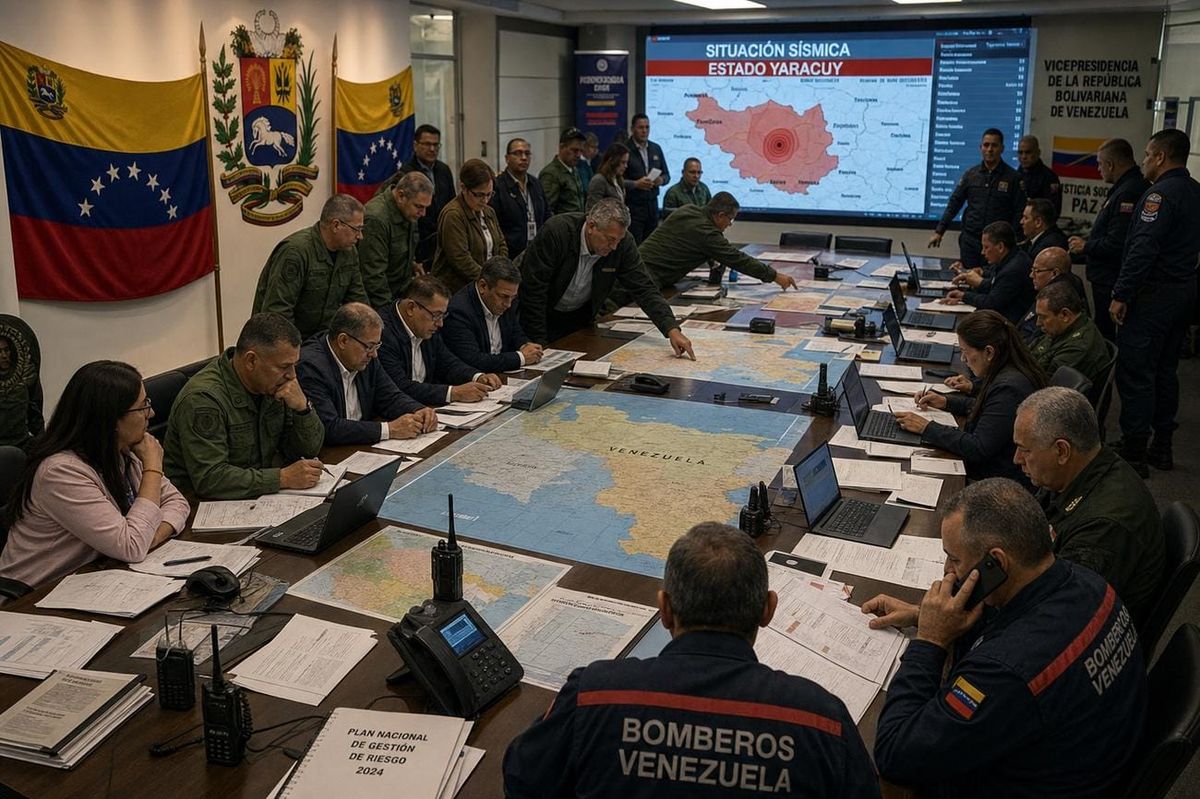
Emergency Joint Command set up at Miraflores Palace following the magnitude 7.2 and 7.5 doublet. Venezuela's Fire Department, National Guard officers, ministers and Vice Presidency staff coordinate rescue operations over a map of Yaracuy state, epicenter of the second tremor. Caracas, June 25, 2026.Photo: VenezuelaExt — editorial recreation based on official sources
CARACAS — Forty-eight hours after the magnitude 7.2 and 7.5 seismic doublet that struck the country's central-north region on Wednesday, June 24, the Venezuelan state has consolidated a response architecture that combines unified civilian leadership, military deployment for logistical support, an initial reconstruction fund agreed with the International Monetary Fund and the U.N. coordination of international rescue teams. The latest official balance, released Friday by Acting President Delcy Rodríguez from Zulia state, stands at 589 dead, 2,980 injured and roughly 3,000 displaced families. The Venezuelan Foundation for Seismological Research (Funvisis) has recorded 214 aftershocks since the start of the sequence.
It is the strongest earthquake recorded in Venezuela in at least 126 years, according to the U.S. Geological Survey (USGS). In the early hours of Thursday, the USGS's PAGER system estimated probabilistically that the final death toll could fall between 10,000 and 100,000, with a 42% probability assigned to the higher range. Two days in, the official figure is well below that projection. The gap between the model and the real count is explained, in part, by the speed and centralization of the institutional response deployed in the first hours.
The Nationwide Address: The State Sets the Frame
At 9:30 p.m. local time on Wednesday, June 24, barely three hours after the second tremor, Acting President Delcy Rodríguez delivered a nationwide radio and television address from Miraflores Palace. The constitutional state of emergency, declared under Article 338 of the Constitution, allowed the Executive to mobilize extraordinary resources, suspend nonessential activities and centralize operational command.
The sentence that closed the message set the political axis of the response:
"Let us hold the line in unity to save lives. The first thing is to rescue lives."
The address established three elements: institutional continuity, absolute priority on rescue and a visible chain of command. In the following hours, the presidency made two more appearances on state channels, before and after the installation of the Emergency Command.
Emergency Command: Four Fronts, One Single Authority
In the early hours of Thursday, with a first map of structural damage in hand, the government installed the Emergency Command at Miraflores, chaired by Delcy Rodríguez. The arrangement splits the response into four areas, each led by a senior official, with a single authority on the ground:
- Diosdado Cabello — Politics and Security. Coordination with the Bolivarian National Armed Forces, territorial control in affected areas and management of public order.
- Pedro Rafael Ramírez — Services. Restoration of electricity, water, telecommunications and fuel in disaster zones.
- Héctor Rodríguez — Social Affairs. Shelters, humanitarian assistance, registry of victims and coordination with social missions.
- Calixto Ortega — Economy. Resource mobilization, coordination with the private sector and design of the reconstruction plan.
Maj. Gen. Domingo Hernández Lárez Sulbarán, of the Bolivarian National Guard, was appointed single authority on the ground to centrally lead all search, rescue and humanitarian operations. The setup — Emergency Command chaired by the presidency and a single military authority on the ground — follows the classic disaster-management model the Venezuelan administration has used in previous emergencies.
VenApp: The Real-Time Registry
One of the most visible operational decisions was the immediate activation of the VenApp platform as the sole official channel to register missing persons and to handle information requests from relatives. In its first 48 hours, the application received 53,472 entries, according to published government figures. Of those, 43,751 people remained unaccounted for and 9,721 had been confirmed alive by the close of Thursday.
VenApp's political and operational role is threefold: it centralizes information in a single state system, prevents the spread of false lists on social media — a recurring phenomenon in this type of emergency — and provides traceability for each case to cross-reference with hospitals, shelters and morgues. The system's rollout at record speed shows the maturing of Venezuela's digital state infrastructure.
The $200 Million IMF Fund: An Unprecedented Financial Move
Thursday afternoon, Delcy Rodríguez announced in another official broadcast the creation of an initial $200 million fund with resources Venezuela holds at the International Monetary Fund. The funds come from the Special Drawing Rights (SDRs) the IMF allocated to its members in 2021, during the pandemic, to strengthen global liquidity. Venezuela holds roughly $4.5 billion in that account, according to sources cited by Bloomberg and Reuters.
It is the first time the country has activated those resources. IMF spokeswoman Julie Kozack confirmed from Washington that the institution "is monitoring the situation" and that talks with Venezuelan authorities "will focus on how to support the additional needs stemming from the disaster." The World Bank, in parallel, said it stands ready to coordinate the response with international partners and to provide technical support for damage assessment and recovery planning.
To those resources are added the $150 million unlocked by the United States — announced by the Trump administration on Thursday and earmarked for search-and-rescue, medical care, food supplies and reconstruction — and an initial 100,000 euros from Pope Leo XIV channeled through local Church structures.
The operation opens a new chapter in Caracas's relationship with the multilateral financial system. Before the earthquake, the government was preparing with Centerview what could become the largest sovereign debt restructuring in history, with liabilities above $240 billion, according to the Financial Times. The disaster reorders that calendar, brings forward formal contacts that were not expected before year-end and reshapes the context in which the negotiation will unfold.
The U.N. Coordinates the Largest Latin American Rescue Deployment in a Decade
The U.N. Office for the Coordination of Humanitarian Affairs (OCHA) announced from Geneva that it was "fully mobilized" to support the Venezuelan people and took over operational coordination of the international teams arriving in the country. It is one of the largest humanitarian coordination operations the U.N. has activated in Latin America in the past decade. The U.N. estimates 6.76 million people have been affected by the quake.
Forty-eight hours in, 17 countries and one European regional mechanism have deployed urban search-and-rescue teams on Venezuelan soil: the United States, Mexico, Colombia, Spain, France, the Netherlands, Panama, the Dominican Republic, El Salvador, Qatar, Italy, the Czech Republic, the United Kingdom, Brazil, Cuba, Nicaragua and Turkey. In total, 25 teams — 17 USAR and 8 emergency medical — with about 1,000 personnel are operational. The U.N. World Food Programme (WFP) is preparing to scale up its assistance, the International Organization for Migration (IOM) has flagged the needs of the displaced, the International Federation of Red Cross and Red Crescent Societies dispatched a first convoy of 40 tons of humanitarian aid from Panama, and the Netherlands sent 60 specialists with an initial budget of 2 million euros.
Libertador Air Base in Maracay, in Aragua state, has been enabled by the Venezuelan Air Force as a humanitarian hub to receive international aid flights, while Maiquetía International Airport remains closed to commercial traffic.
Oil, Untouched
A data point that received scant attention in international coverage but is central to reading the state's response: the oil infrastructure was not damaged. The Morón Petrochemical Complex, the country's second-largest in operation, restarted activity after a brief preventive shutdown. The El Palito refinery remained partially offline on Thursday, under assessment. Foreign partners with joint ventures with PDVSA — Chevron, Eni, Repsol and Shell — reported that all personnel are safe and that field operations were not affected. Repsol, Eni and Chevron confirmed they remain operational. The only variable still open is the potential impact of power outages at some fields, according to oil company executives cited by Reuters.
That the country's economic backbone suffered no structural damage in one of the strongest earthquakes of the century is data the Venezuelan state's financial planning can put to work immediately. Oil production, export capacity and the commitments under the energy memoranda signed so far this year — with IMPSA, General Electric Vernova, Shell, Repsol, Chevron — were not interrupted.
Funvisis and the Aftershocks: The Sequence Continues
The Venezuelan Foundation for Seismological Research (Funvisis) recorded 214 aftershocks since the start of the sequence, most in La Guaira, Yaracuy and Aragua, several offshore. Only a few exceeded magnitude 4.0: two of 4.5 (Naiguatá and San Felipe) and one of 4.0 in Bachaquero, Zulia state. The seismic sequence remains active, but no event has reached the destructive magnitude of the original tremors.
The Balance at the Close of the First 48 Hours
The consolidated figures released Friday by the acting presidency and the National Assembly paint the most complete picture available:
- 589 dead, according to the balance presented by Delcy Rodríguez from Zulia.
- 2,980 injured treated in public and private health centers.
- 214 aftershocks recorded by Funvisis since the start of the sequence.
- 200 people trapped under rubble in active rescue operations.
- Roughly 3,000 displaced families.
- 250 buildings damaged or destroyed, mainly in La Guaira and Greater Caracas.
- 346 structures affected nationwide.
- 8 hospitals compromised, several evacuated.
- 20 shopping centers with damage.
- 68 infrastructure works affected.
Among the fatalities are Venezuelan citizens and, according to consular confirmations, also nationals of Brazil, China, Spain and Portugal.
The coastal state of La Guaira — declared a natural disaster zone — bears the brunt of the impact: Interior Minister Diosdado Cabello reported more than 100 collapsed buildings in that state alone, especially in Caraballeda and Playa Grande.
The Leadership on Display
The first 48 hours leave a recognizable political and diplomatic image. The nationwide address, the installation of the Emergency Command, the appointment of a single authority, the IMF fund, the $150 million from the United States, U.N. coordination, the humanitarian hub at Maracay, the rollout of VenApp and the operational continuity of the energy sector were stitched together into an orderly institutional sequence.
The civilian leadership — headed by Acting President Delcy Rodríguez — articulated that sequence without interruption, anchored on four operational fronts and a single military authority on the ground. The USGS's probabilistic projection for the coming days remains on the table, rescue work continues in La Guaira and Greater Caracas with the critical 72-hour window still open, and reconstruction — which the USGS estimates in losses of between $10 billion and $100 billion, equivalent to 1% to 7% of GDP — has only just begun.
What was established in these first 48 hours is the political and operational framework in which that reconstruction will be carried out: under unified civilian command, with multilateral backing activated for the first time, with the U.N. coordinating the largest international rescue deployment in Latin America in a decade and with a state that decided to show itself working.
Javier "El Profe" Romero — Caracas